Waste wood A I–A III: what the class does in the firebox
Waste wood is cheap and plentiful, but it brings alkalis, chlorine, heavy metals and foreign matter in far larger quantities than virgin wood. What changes in the combustion chamber between A I and A III, which zones react first, and what to check on the lining when switching from virgin wood to waste wood.
For many wood and biomass firing plants, waste wood is the obvious answer to scarce and expensive forest wood chips: available, high in calorific value, and the disposal companies are looking for buyers. In the combustion chamber, however, it is a different fuel from virgin wood, and all the more so the higher the category. What it brings in addition can be grouped into four headings: alkalis, chlorine, heavy metals and foreign matter. All four hit the same lining, and none of them appears on the delivery note.
Four categories under the Waste Wood Ordinance (AltholzV)
A I: untreated waste wood or wood that has only been mechanically processed, such as solid-wood pallets or untreated crates. Chemically close to virgin wood, but often with nails, staples and adhering soil.
A II: glued, painted, varnished or coated wood without organohalogen compounds and without wood preservatives, such as chipboard, furniture remnants and interior fittings. Binders and coatings bring in nitrogen, alkalis and pigments.
A III: waste wood with organohalogen compounds in the coating, typically PVC-coated or PVC-laminated parts, without wood preservatives. This is where chlorine enters the combustion chamber in large quantities. Like A IV, it may only be used for energy recovery in plants under the 17. BImSchV (German ordinance on waste incineration), i.e. under the stricter requirements that waste incineration places on firing and flue gas.
A IV: wood treated with wood preservatives, such as railway sleepers, utility poles or exterior timber. Like A III, it belongs in plants under the 17. BImSchV and is not an issue for wood-fired plants under the 4. BImSchV (German ordinance on installations requiring a permit), where only A I and A II are permitted.
The category says something about origin and legal framework, but little about what the fuel actually contains. Two A II deliveries from different sources can differ more in chlorine, potassium and foreign matter content than A I and A II do on average. For the lining, therefore, the analysis counts, not the label. And the fluctuation counts more than the average: a consistent, middling fuel is easier for the lining to cope with than a good one that jumps.
Alkalis: the ash melts earlier
Potassium and sodium lower the temperature at which ash softens and starts to stick. For untreated wood the ash softening point is typically in the order of 1,200 °C; for contaminated waste wood it can be several hundred degrees lower. Sodium comes not only from the wood itself but also from glass, coatings and wood-based panels. The result is slagging exactly where the combustion chamber is hottest and tightest: at the grate edge and on the side walls above the fuel bed. At the same time, alkalis migrate as vapour into the pores of the working layer, form new phases there with the aluminosilicate that have a different expansion behaviour, and the surface layer spalls off at the next temperature change.
Chlorine and heavy metals: the damage sits behind the wall
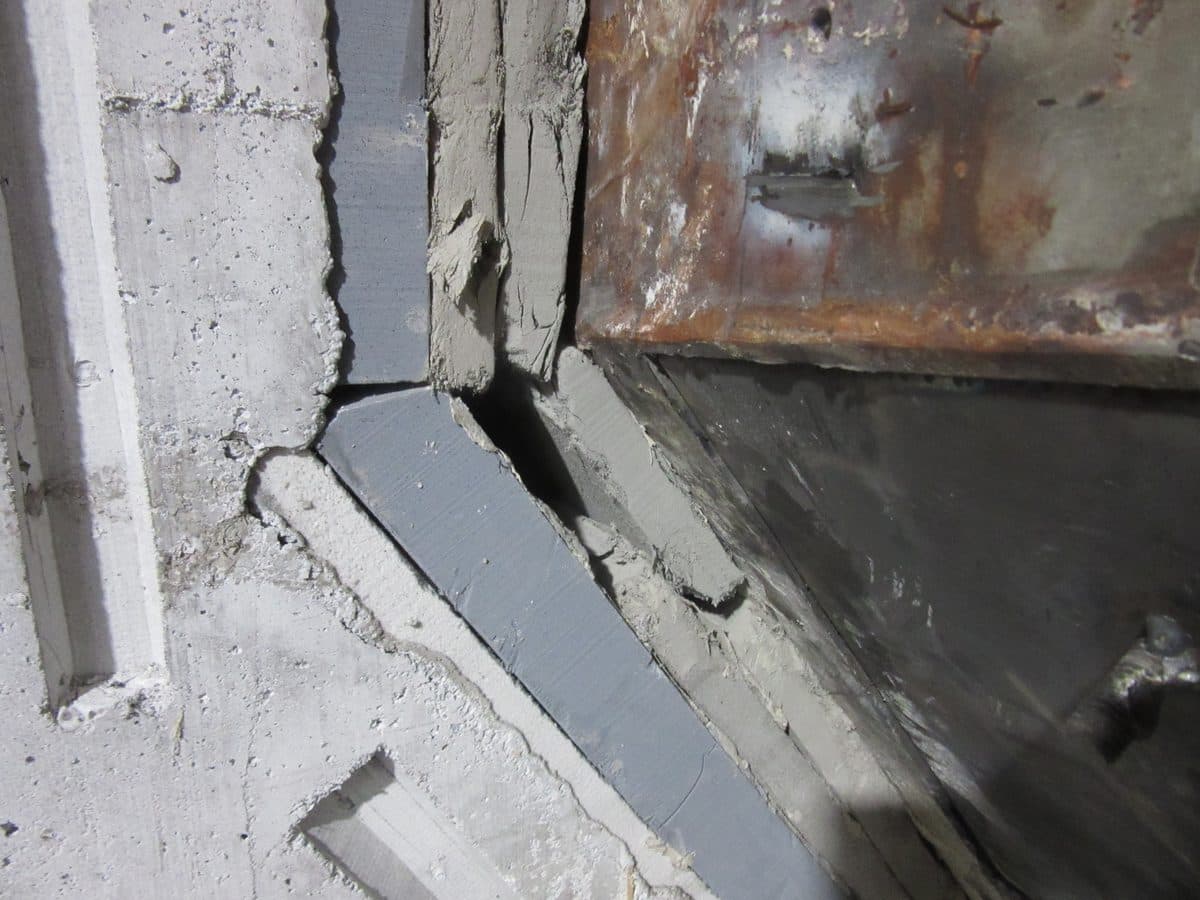
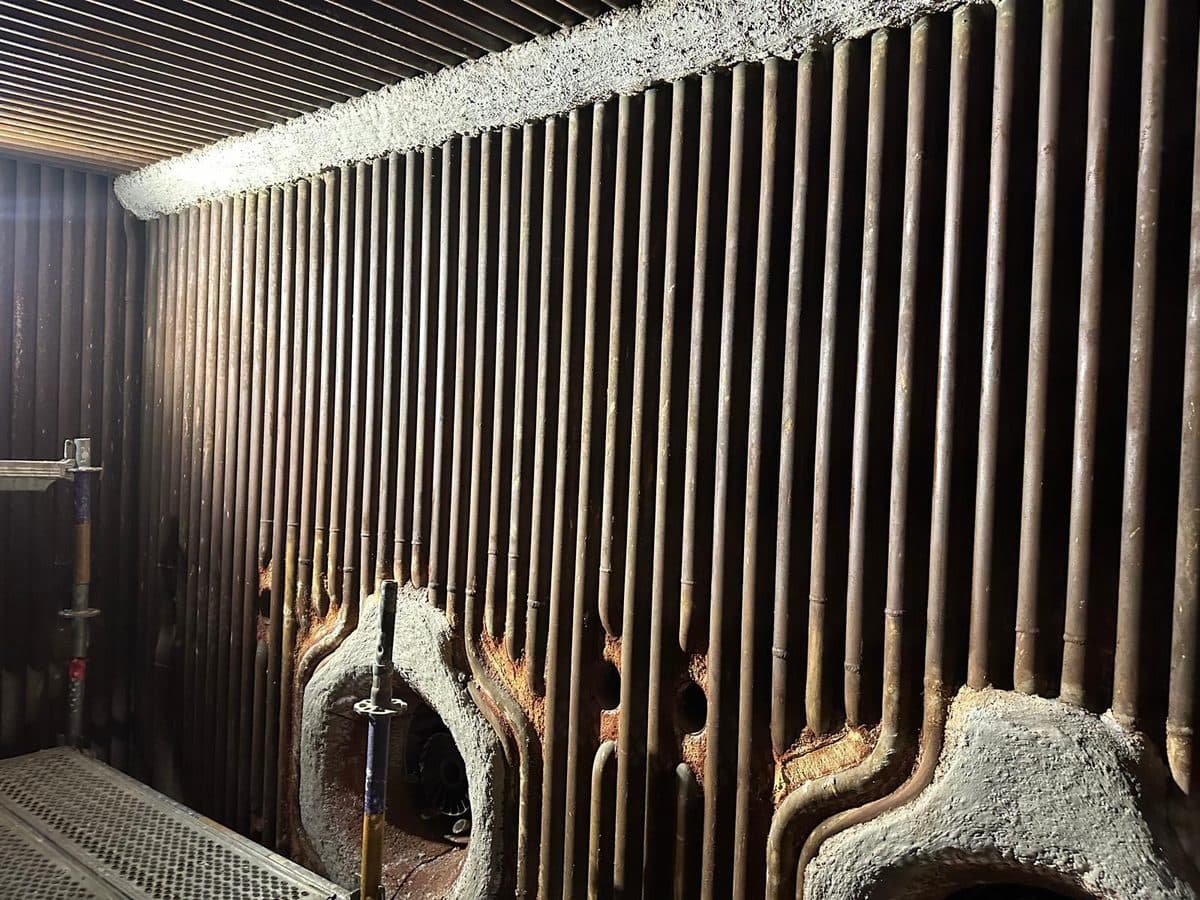
Chlorine attacks the lining less than what lies behind it. Together with the alkalis it forms chlorides that melt at comparatively low temperatures and migrate outwards in liquid form through joints, cracks and open pores. Where they meet steel — anchors, tube wall or shell — they dissolve the protective oxide layer and let corrosion run deep. Zinc and lead from varnishes, paints and fittings make this worse: their chlorides melt even earlier. From the outside nothing can be seen for a long time. The surface is intact until a panel falls because the anchors behind it have corroded away.
Foreign matter: glass sticks, sand abrades, metal strikes
Waste wood is never just wood. Nails, screws and fittings, broken glass from windows and doors, sand, plaster and concrete residues from demolition all travel over the grate. Glass softens far below the combustion chamber temperature and forms a viscous melt with the ash that builds up on grate and wall. On the moving grate, sand and mineral fractions act like emery: hour after hour the fuel bed pushes them along the side wall, and the wall wears away before it slags. Metal parts add mechanical impact at the grate edge and wherever fuel lands.
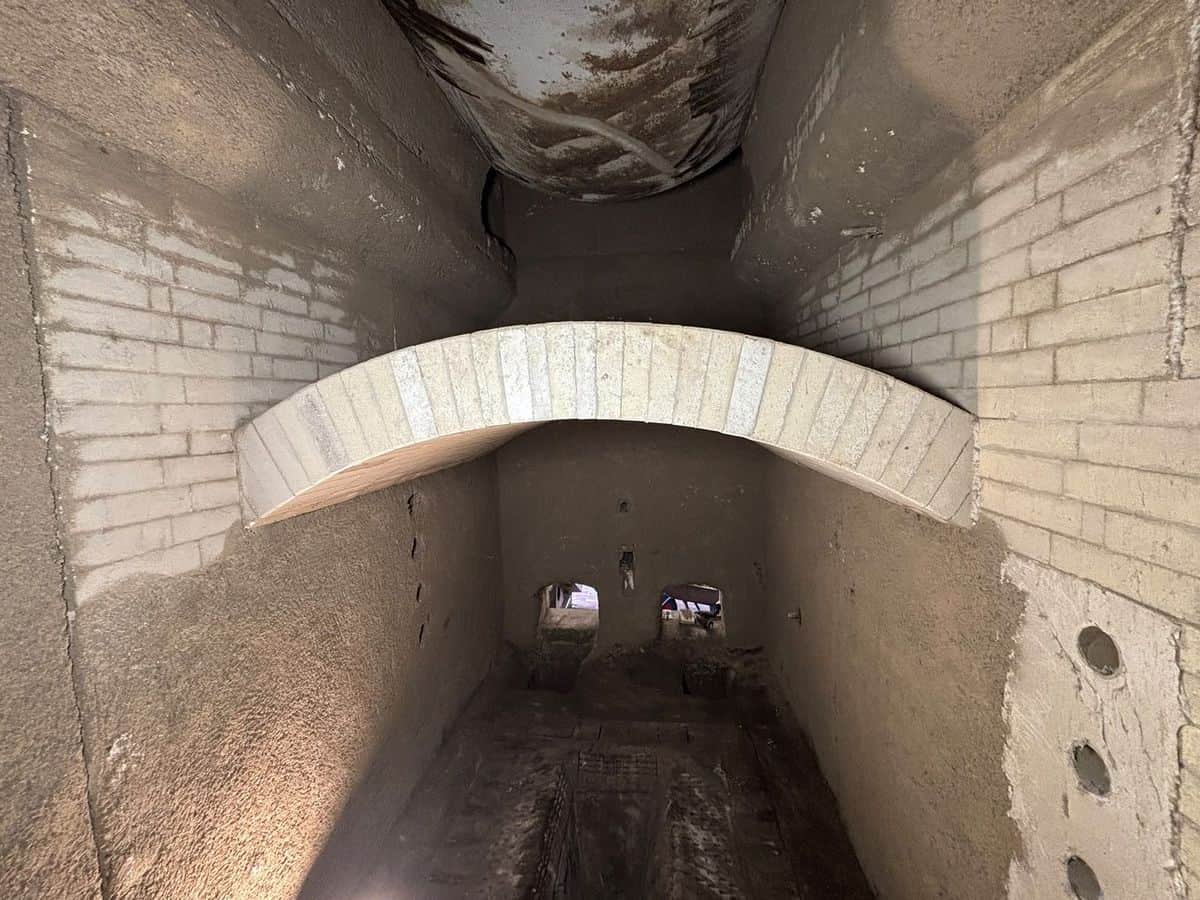
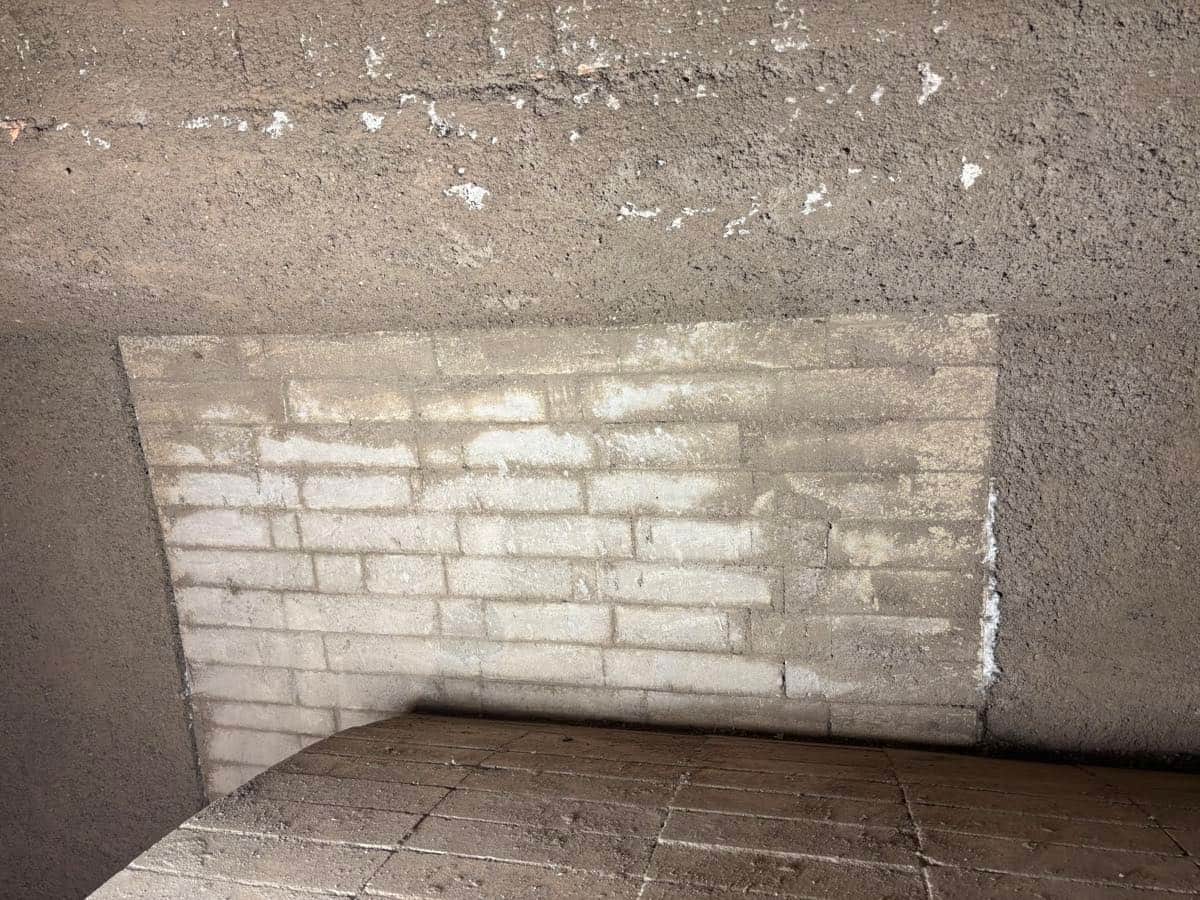
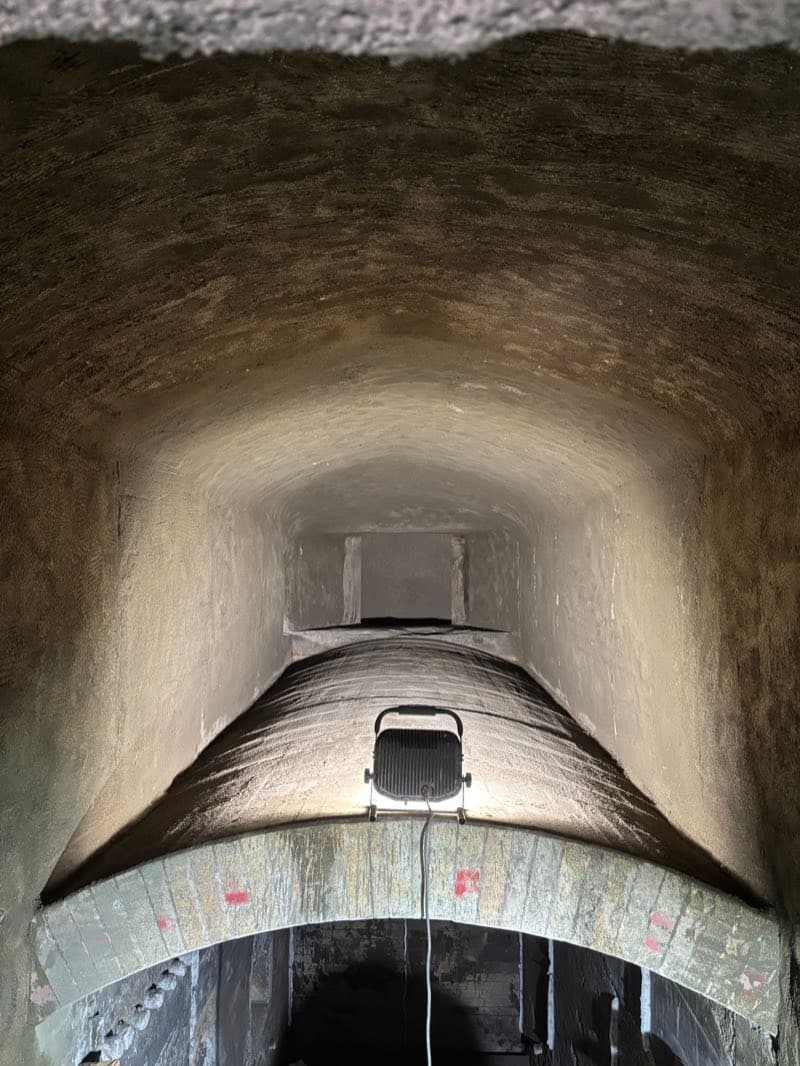
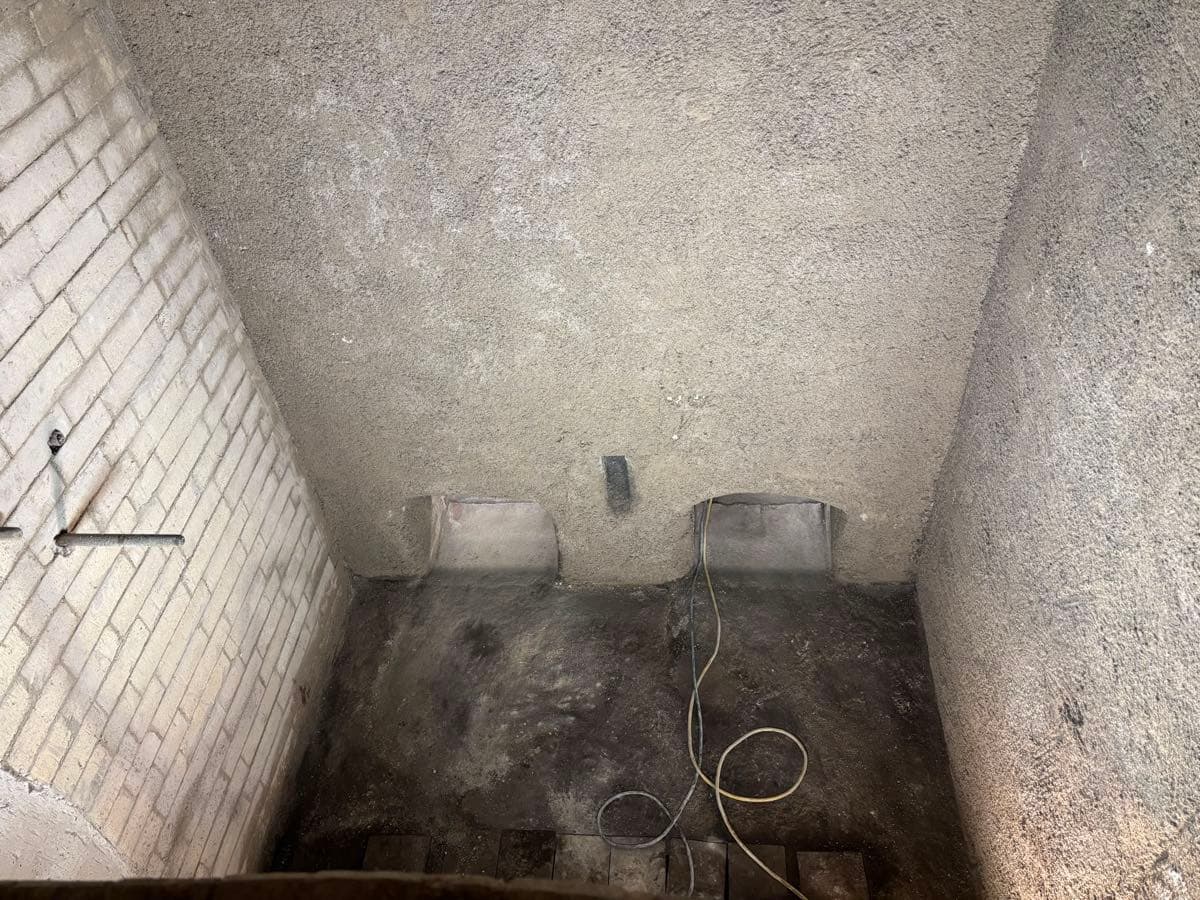
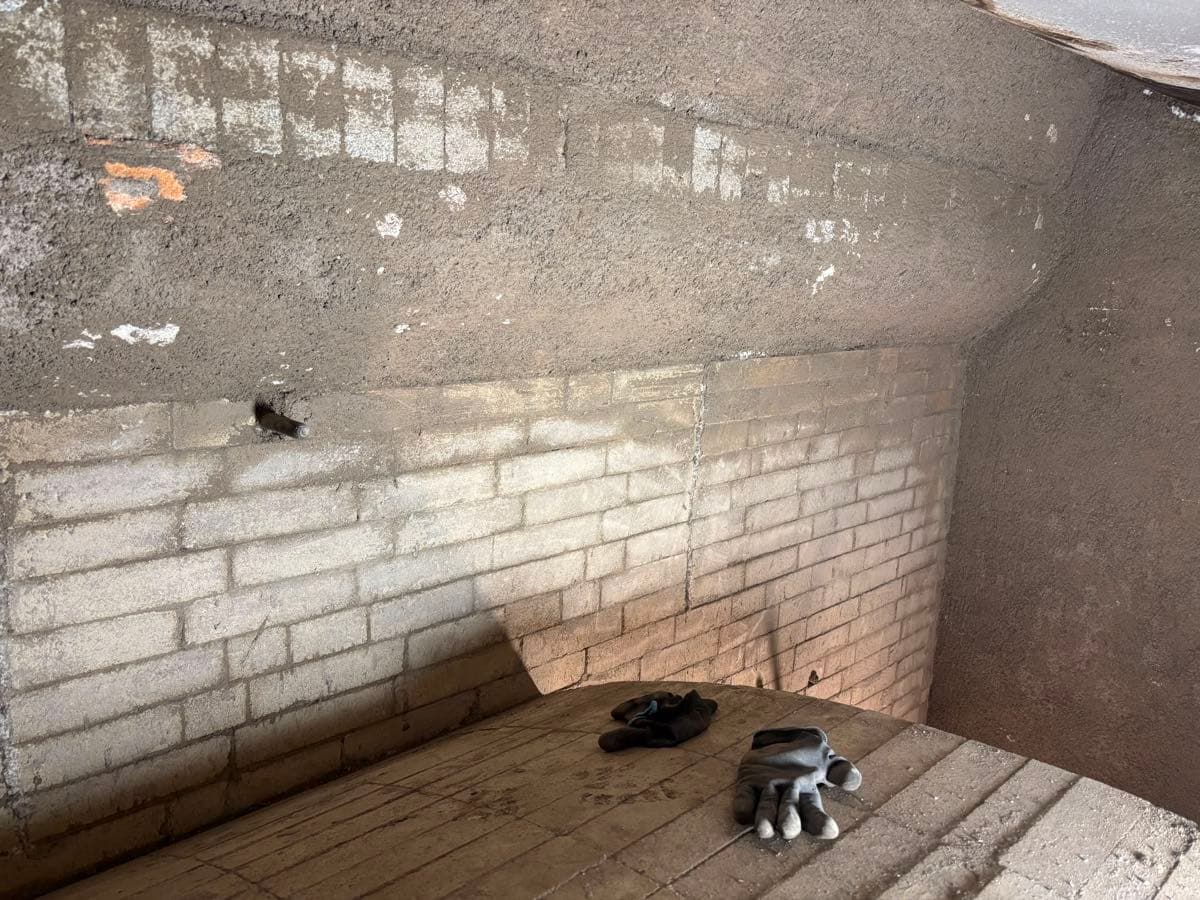
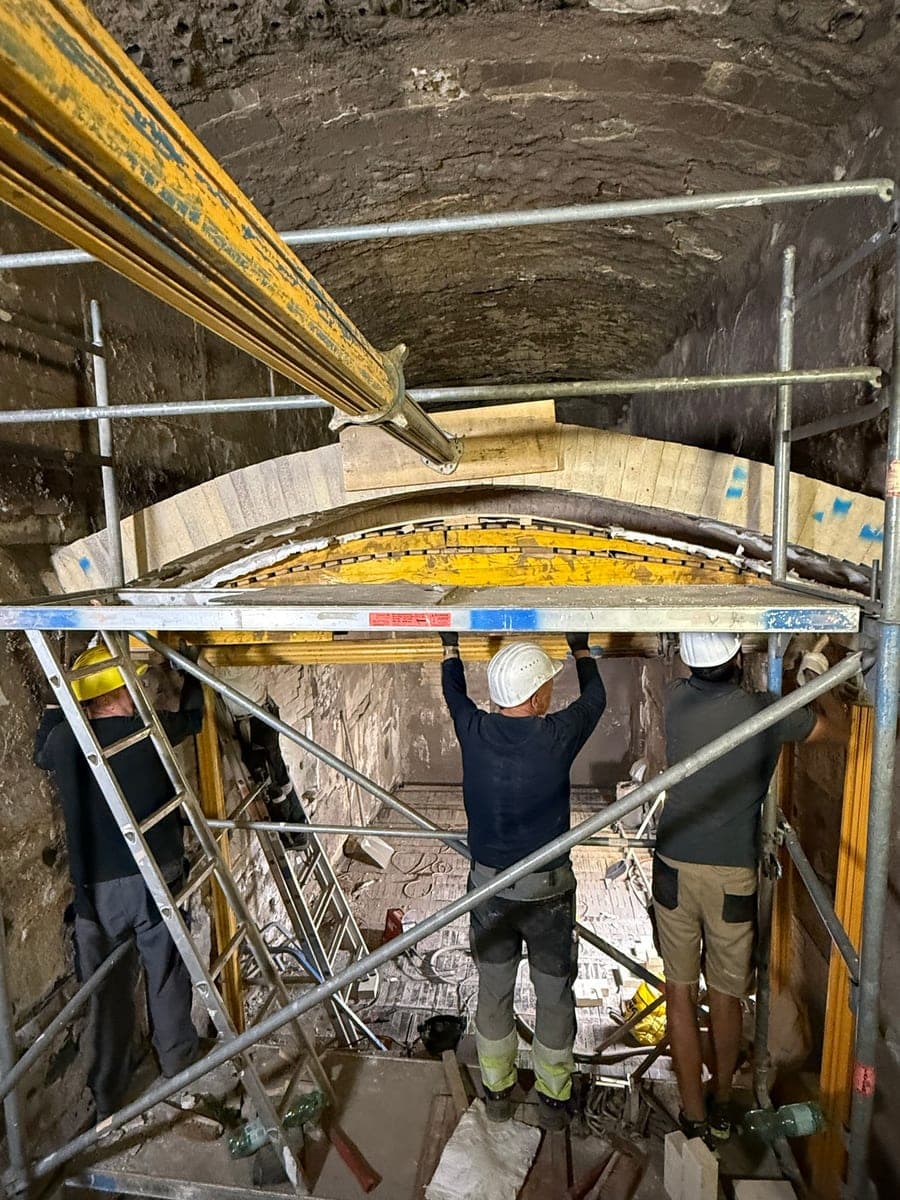
Arch, brick wall, gunning mix and nozzles in one chamber: each of these materials reacts differently to a new fuel, and there is a joint at every transition
What this means for the lining
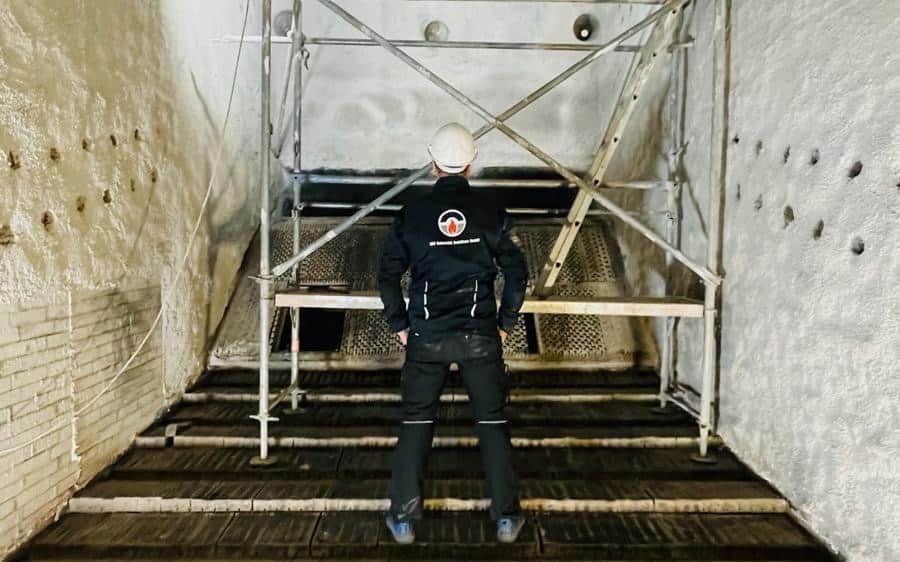
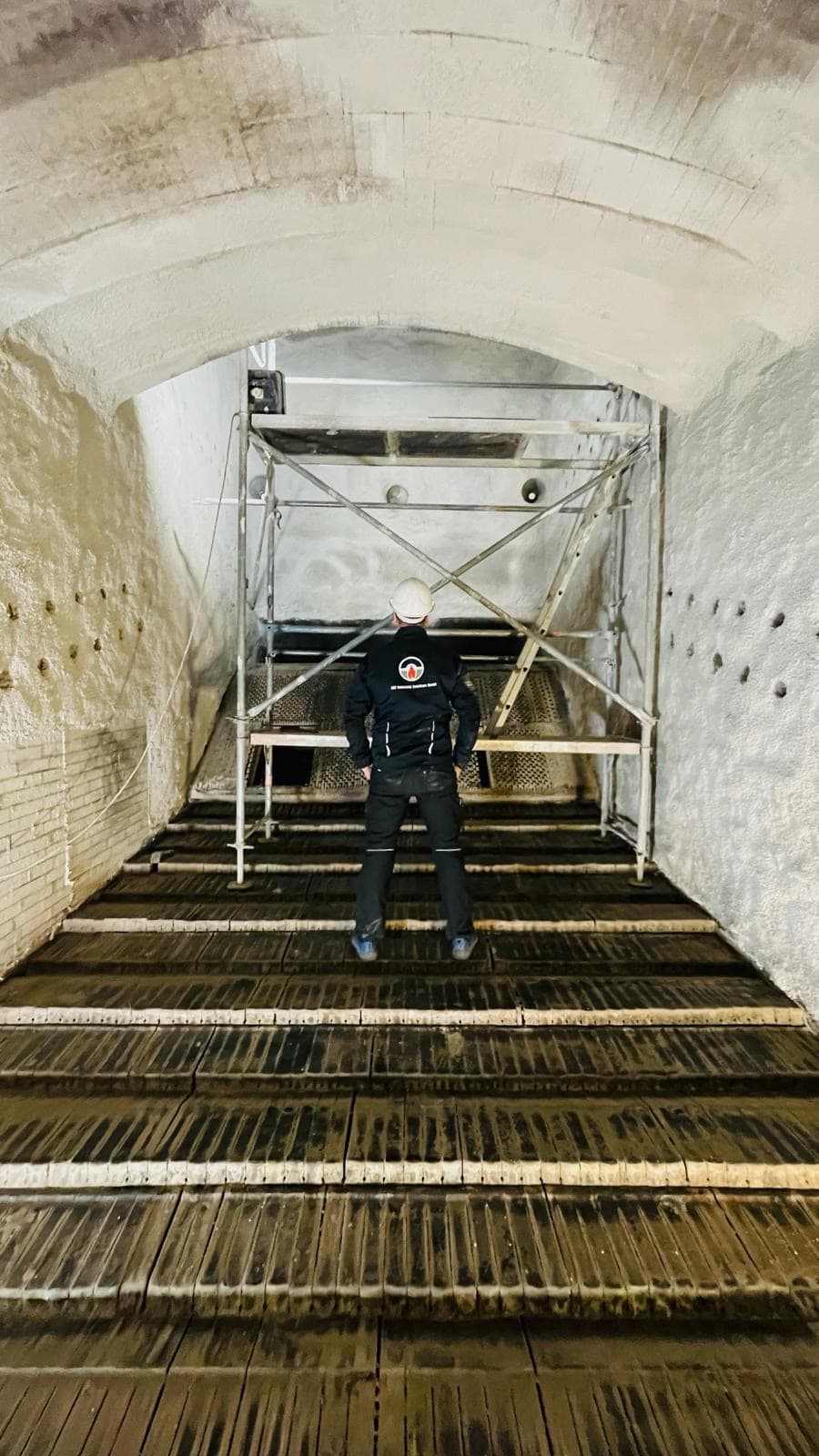
Where the area near the grate is lined monolithically, SiC-containing gunning mixes and castables have proven themselves. Silicon carbide conducts heat away better than fireclay; in front of a cooled tube wall the surface therefore stays cooler. Slag adheres less well, and the material withstands abrasion by sand and ash for longer. Where that area is bricked, the same reasoning applies to the brick: dense and alkali-resistant instead of open-pored. Which grade fits is a question to put to the supplier together with the fuel analysis. The first twenty to thirty centimetres next to the grate are assessed separately: that is where slag, sand and alkalis hit the wall first.
For the surfaces above: dense before open. A hot face with low open porosity lets alkalis and chlorides penetrate more slowly, and a smoothly finished surface gives deposits less to hold on to. The price is lower thermal shock resistance, so heat-up after the lining work calls for more care. In the zones at risk from chlorine, monolithic surfaces have an advantage over bricked panels because they have fewer joints through which chlorides can migrate to the steel.
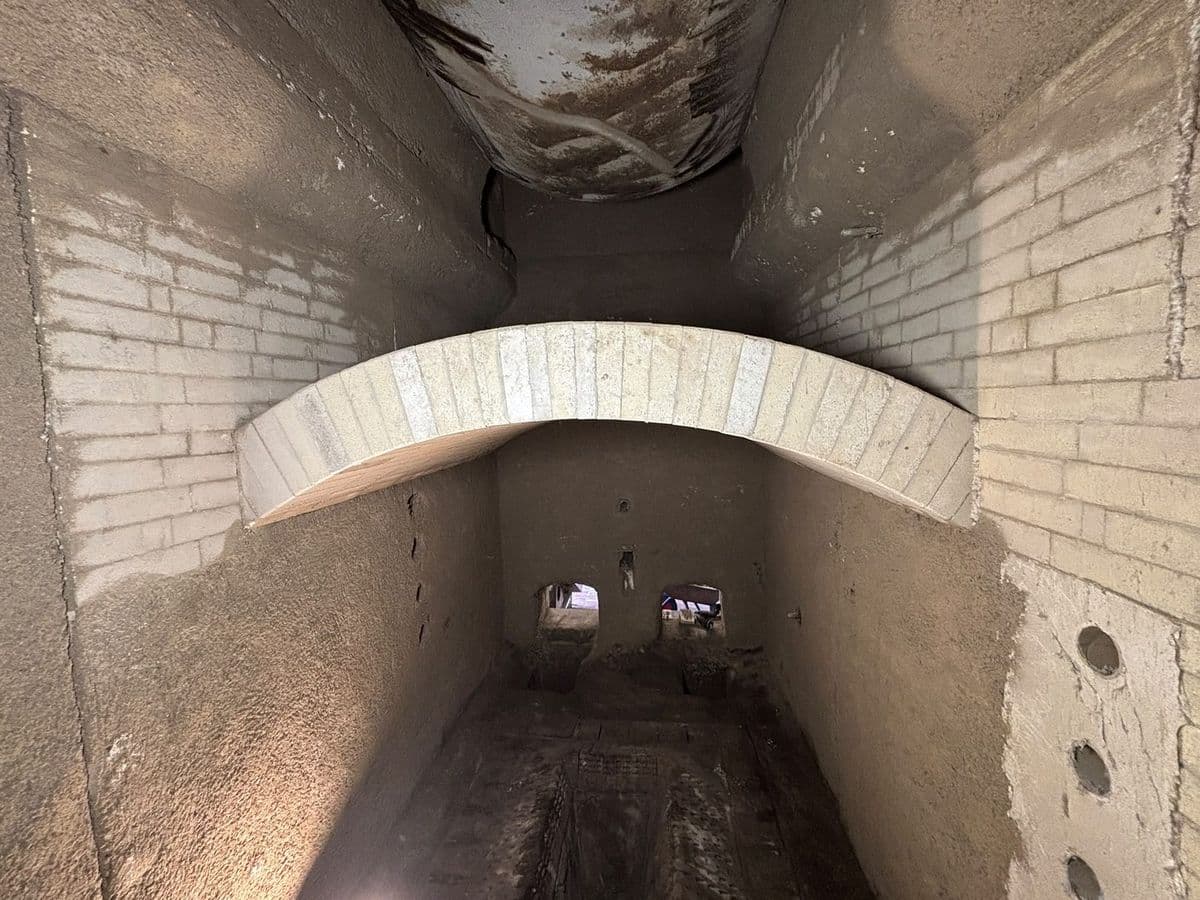
Brick meets gunning mix directly above the grate: it is at transitions like these that chlorides find their way to the steel
In the hot zones the anchors must be made of heat-resistant steel such as 1.4841; mild steel scales away there. But even 1.4841 is not a permanent part under chlorine load: the anchor sits cooler than the furnace side and therefore exactly in the temperature range in which chlorides condense. Anchors are therefore inspected at every opening and, if in doubt, replaced rather than reused. Then there are the expansion joints. The grate expands, the wall stays put, and SiC-containing materials expand differently from fireclay. The joint between grate and lining is a wear part, and expansion joints in the surface are closed with ceramic fibre mat so that they can work without slag and chlorides running into them.
What we see in our overhauls
In our annual overhauls of wood and biomass boilers we work with gunning mixes such as DoriDur RC 1550 or Seven Gun 63, with a two-component special plastering castable (Formula 6P), with ceramic fibre mat 1260/128 and mineral wool behind it. This build-up is matched to the fuel the boiler has been running on so far. If the fuel changes, it is not automatically wrong, but it has to be reassessed: whether the working layer near the grate suits the new fuel, whether the joints are tight enough, and whether the anchors behind the surface can cope with the chlorine. The findings often follow the fuel only with a delay of one heating season. Anyone who does not connect the two repairs the same spot every year without seeing the cause.
For the overhaul intervals this means: what runs well on virgin wood with an annual overhaul can become too tight after switching to waste wood. How much the interval will shorten cannot be quantified reliably in advance. What is reliable is the way to find out: an interim inspection in the first heating season after the switch, cleaning according to the state of the deposits rather than the calendar, and a comparison with the findings from before the switch.
Checklist: from virgin wood to waste wood
Request a fuel analysis to standard, not just the category: chlorine, sulphur, potassium, sodium, ash content and ash melting behaviour, plus zinc and lead.
Have several deliveries analysed, not one. For the lining, the fluctuation matters more than the average.
Clarify the foreign matter content: is metal separated out, are glass and mineral matter screened out, and how is this set down in the supply contract?
Photograph and measure the grate edge and the first twenty to thirty centimetres of side wall before the switch. Without a baseline, every later finding is just a snapshot.
Have the supplier check the working layer near the grate against the analysis: is today's material sufficient, or does an SiC-containing grade belong there?
Plan a trial opening at a representative spot: check anchor material, anchor condition and insulation layer before the chlorine arrives.
Check expansion joints and the joint between grate and lining along their full length and renew them if necessary.
Schedule an interim inspection in the first heating season after the switch, with the same measuring points as before, and keep fallen pieces labelled.
Between A I and A III, it is less the calorific value that changes than what the combustion chamber has to withstand: earlier slagging from alkalis, corrosion behind the wall from chlorine and heavy metals, abrasion from sand and glass. Anyone who assesses the switch on the lining beforehand does not pay for it with the next shutdown. How to do this step by step, with inspection sheets, a list of questions for the supplier and building blocks for the supply contract, is set out in the fuel-switch strategy paper “When the fuel changes, the wear changes” in the Download Center.
At a glance
A I–A IV
waste wood categories under the AltholzV: the category describes origin and legal framework, not the analysis
20–30 cm
next to the grate to be assessed separately: that is where slag, sand and alkalis hit the wall first
1.4841
heat-resistant anchor steel for the hot zones, yet still a wear part under chlorine
We use cookies and similar technologies to ensure that our website functions properly and to analyse how our content is used. In the settings you can choose which cookies you wish to allow. Privacy policy

 PDFEnergy & Combustion