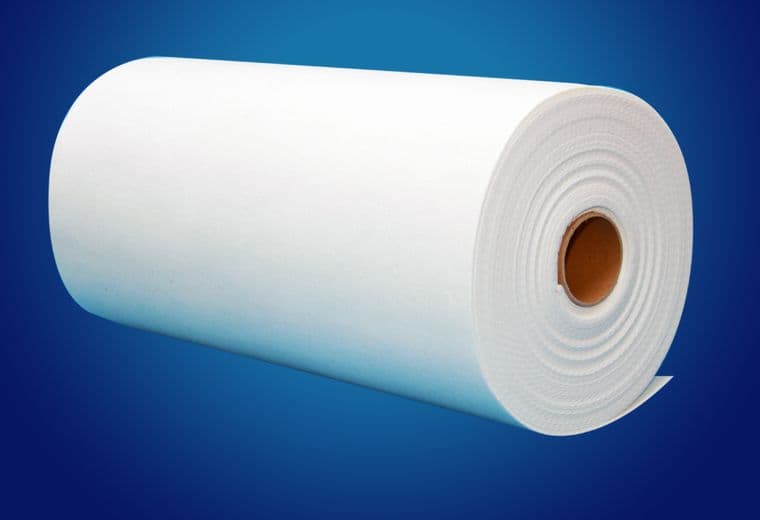
SOLUT BW Blanket, bio-soluble fibre blanket on a roll
SOLUT BW · AES

Bio-soluble high-temperature insulation wool (AES)

Alkaline earth silicate wool (AES) dissolves quickly in lung tissue and is therefore not classified as carcinogenic, unlike alumino-silicate wool (ASW/RCF). We supply it as blanket, board and paper, with data sheet, cutting and, on request, installation by our own fitters.

Classification temperature
1200 °C
Supply forms: blanket, board, paper
3
Alkaline earth silicate
SiO₂ · CaO · MgO
Languages per data sheet
13
In brief

How bio-soluble fibres differ from ceramic fibre

High-temperature insulation wool insulates industrial furnaces, boilers and pipes above approx. 600 °C. The classic material is alumino-silicate wool, commonly called ceramic fibre (ASW, also known as RCF). In the EU it has a harmonised classification as carcinogen category 1B.

Alkaline earth silicate wool (AES) consists of silica with calcium and magnesium oxide. Its fibres remain in lung tissue only briefly: they are bio-soluble, or in technical terms of low biopersistence. That is why the CLP Regulation provides an exemption from classification as carcinogenic for such fibres (Note Q). In the data sheet you can recognise AES by SiO₂ / CaO / MgO instead of Al₂O₃ / SiO₂.

PropertyAES bio-soluble (SOLUT BW)ASW / RCF (SOLUT ST · HA · HT)
CompositionSiO₂ with CaO and MgO (alkali and alkaline earth oxides > 18 %)Al₂O₃ and SiO₂, some with ZrO₂ (alkali and alkaline earth oxides ≤ 18 %)
Classification under CLPMineral wool entry (Carc. 2) with Note Q: not classified as carcinogenic if bio-solubility has been demonstratedCarcinogen category 1B, H350i (Index No. 650-017-00-8)
REACHnot on the Candidate ListOn the Candidate List since 13 January 2010; duty to inform under Art. 33 from 0.1 % by mass
Occupational safety in GermanyTRGS 558 does not apply; basic duties under § 8 GefStoffV and TRGS 500TRGS 558 with exposure categories; substitution assessment under TRGS 619
Occupational exposure limitgeneral dust limit valueEU limit value 0.3 fibres/ml (Directive 2004/37/EC); in Germany acceptable and tolerable concentrations under TRGS 558
Classification temperatureSOLUT BW: 1200 °CSOLUT: 1260 / 1350 / 1430 °C

Simplified overview; it does not replace a risk assessment. The classification temperature is not a service temperature, see Service limits.[1, 2, 3, 4, 5, 6]

Our AES range

SOLUT BW: blanket, board and paper

All values from our material data sheets, each data sheet available in 13 languages for direct download.

SOLUT BW Blanket, bio-soluble fibre blanket on a roll
AES bio-solubleBlanket

SOLUT BW Blanket 1200

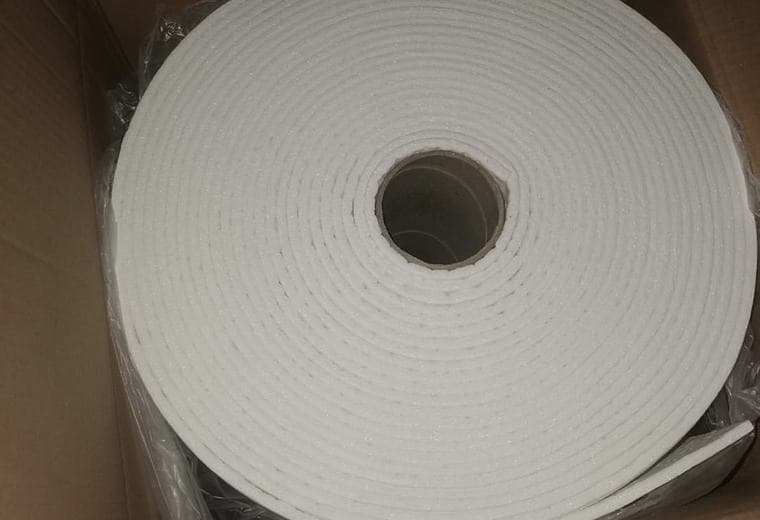
Long-fibre blanket, needled on both sides, for back-up insulation, crowns, expansion joints and pipes.

Classification temperature
1200 °C
Bulk density
64 · 96 · 128 · 160 kg/m³
λ at 600 °C (64 · 96 · 128 kg/m³)
0.17 · 0.13 · 0.12 W/m K
Thicknesses
6–50 mm, roll 610 mm
To the material page
SOLUT Board fibre boards in various thicknesses
AES bio-solubleBoard

SOLUT BW Board 1200

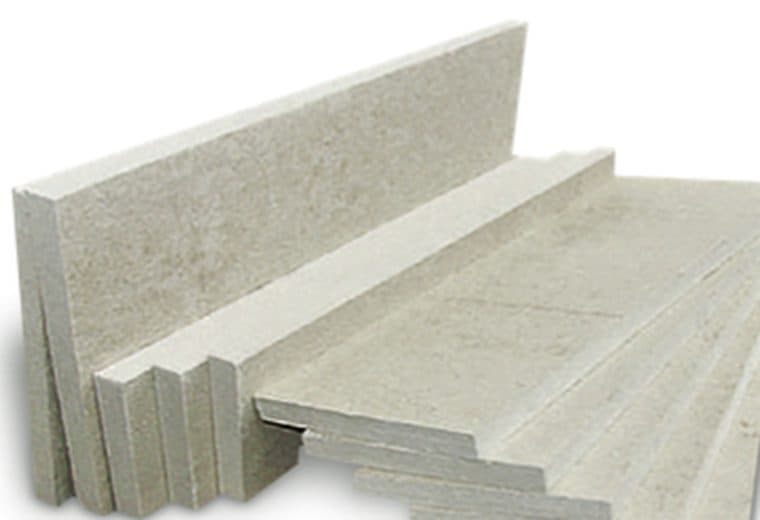
Pressed fibre board, the bio-soluble variant of SOLUT Board: dimensionally stable for furnace doors, covers and load-bearing insulation layers.

Classification temperature
1200 °C
Bulk density
300 kg/m³
Flexural strength
≥ 0.25 MPa
λ at 600 °C
0.11 W/m K
To the material page
SOLUT Paper fibre paper on a roll
AES bio-solublePaper

SOLUT BW Paper

Thin, flexible fibre paper for seals, interlayers and insulation where space is tight.

Classification temperature
1200 °C
Bulk density
200 kg/m³
Loss on ignition
4–8 %
λ at 600 °C
0.11 W/m K
To the material page
SOLUT BW Board is included in the data sheet “SOLUT Board and BW Board”, SOLUT BW Paper in the data sheet “SOLUT Paper”. Cut pieces, strips and special thicknesses on request. We send safety data sheets with the quotation.
Legal framework

Why operators are switching to bio-soluble fibres

Strict rules apply to alumino-silicate wool in the EU and in Germany. It is not banned, but every use must be justified, monitored and documented.

CLP Regulation: two entries, two classifications

Refractory ceramic fibres with no more than 18 % alkali and alkaline earth oxides are classified as carcinogen category 1B (H350i: may cause cancer by inhalation). Fibres with more than 18 % fall under the mineral wool entry (category 2). Note Q applies to them: the classification need not be applied if a recognised test shows low biopersistence or no carcinogenicity, for example a weighted half-life of long fibres of less than 10 days in the inhalation test.[1, 2]

REACH: substance of very high concern

Aluminosilicate RCF has been on the Candidate List since 13 January 2010, zirconia aluminosilicate RCF since 19 December 2011. Anyone supplying articles containing more than 0.1 % by mass must inform their customers (Art. 33 REACH). In 2014 ECHA recommended making it subject to authorisation. Instead, the EU set a binding occupational exposure limit.[3, 4]

Occupational exposure limit for RCF

Since amending Directive (EU) 2017/2398, a binding limit value of 0.3 fibres per millilitre of air (8-hour average) has applied to refractory ceramic fibres in the EU.[4]

TRGS 558: activities involving high-temperature insulation wool

For work with ASW, TRGS 558, the German Technical Rule for Hazardous Substances, prescribes exposure categories, protective measures and respiratory protection. AES wools are expressly excluded; the general basic duties of the German Hazardous Substances Ordinance (GefStoffV) apply to them.[5]

TRGS 619: assess substitution

TRGS 619 (2026 revision) describes where ASW can be replaced by wools of low biopersistence. Operators must assess substitution and document the result in the risk assessment. According to TRGS 619, AES is generally an option up to 1200 °C.[6]

Removal and disposal

Vitreous high-temperature insulation wool that has been exposed to more than 900 °C can contain cristobalite; TRGS 559 then also applies during removal. This affects both ASW and AES. Unused ASW waste carries waste code 17 06 03*; used wool is classified case by case.[5, 7, 8]

Bio-solubility

What “bio-soluble” means and what it does not

Whether an inhaled fibre causes harm depends above all on how long it stays in the lung. This is measured as biopersistence: the half-life of long fibres (over 20 µm) in the rat lung according to a defined EU test protocol (ECB/TM/27). AES fibres are composed so that they dissolve quickly in lung tissue.[2, 9]

According to the safety data sheet for our SOLUT BW Blanket, the fibre does not meet the classification criteria for carcinogenicity; the low biopersistence of AES fibres has been demonstrated by studies following this protocol. The International Agency for Research on Cancer (IARC) classifies refractory ceramic fibres as possibly carcinogenic (Group 2B); it has not made an overall evaluation of the newer, low-biopersistence wools.[10, 11]

What still applies

  • Fibre dust can mechanically irritate the skin, eyes and respiratory tract. Avoid dust, use extraction, do not dry-sweep or blow off.
  • The basic duties of the Hazardous Substances Ordinance remain: risk assessment, instruction, suitable protective equipment.
  • After use above 900 °C, cristobalite can form, in AES too. Removal then in accordance with TRGS 559.
  • “Bio-soluble” does not mean “harmless”. It means: not classified as carcinogenic.
Service limits

How hot can AES get?

The number in the product name is the classification temperature, not the continuous service temperature. How far below it you need to stay depends on the plant, the atmosphere and the lining build-up.

Classification temperature

Under DIN EN 1094, the temperature at which linear shrinkage after 24 hours does not exceed a limit value: 4 % for blankets, 2 % for boards and shaped parts. It describes shrinkage behaviour, not a service limit.[12]

Continuous service temperature

Lies below the classification temperature and applies only in a clean, oxidising atmosphere. Contamination or a reducing atmosphere lowers it. TRGS 619 generally gives up to 1200 °C for AES; we determine your exact limit with you for the lining build-up.[6, 12]

Chemical limits

According to manufacturer data, AES wools are resistant to most chemicals, but not to hydrofluoric acid, phosphoric acid and strong alkalis. Where alkaline fluxes, salt vapours or slag contact are involved, we check in advance whether AES is suitable or whether another solution will last longer.[13]

Rule of thumb from practice: the further the fibre sits behind the hot face, the better AES fits. In back-up insulation behind brick or castable it is often the first choice; on a directly fired hot face above 1200 °C, ASW or polycrystalline wool remains necessary.
Applications

Where bio-soluble fibres are standard today

Typical installation locations from industry and manufacturer practice, each with our matching product.

Back-up insulation of furnaces and boilers

Insulation layer behind refractory brick, castable or fibre modules, where the temperature at the fibre is well below that of the hot face.

BW Blanket · BW Board

Heat treatment

Bogie hearth, chamber and bell furnaces, expansion joints and crown insulation of tunnel kilns.

BW Blanket · BW Board

Pipes, ducts, launders

Thermal insulation of launders, vessels, pipelines and gas ducts, boilers and reformers.

BW Blanket · BW Paper

Seals and interlayers

Furnace door and flange seals, interlayers and electrical insulation where it has to be thin.

BW Paper

Fire protection and battery storage

Cladding and compartmentation in storage containers, where the load case is an event lasting minutes and a bill of materials free of hazard labelling is required.

BW Blanket · BW Board · BW Paper

Replacement during relining

When we remove an ASW lining, we assess with you which layers can be replaced with bio-soluble material. Our fitters carry out the removal in accordance with TRGS 558.

Substitution assessment under TRGS 619

Where ASW remains necessary: All-fibre linings on the hot face and components with continuous temperatures above the AES range, such as modules in the hot zone, ladle lids or reformer radiant sections. For these we supply SOLUT Blanket HA/HT and SOLUT Module. To the ceramic fibre page
Frequently asked questions

What purchasing, occupational safety and maintenance ask

Are bio-soluble fibres carcinogenic?+

They are not classified as carcinogenic. Under Note Q, the CLP Regulation exempts fibres of this kind from classification if their low biopersistence has been demonstrated. According to the safety data sheet, our SOLUT BW Blanket does not meet the classification criteria. The dust can still cause mechanical irritation.

Do I have to apply TRGS 558 when installing AES?+

No, TRGS 558 expressly excludes AES wools. The basic duties of the Hazardous Substances Ordinance apply: risk assessment, dust avoidance, extraction, suitable protective equipment. If old ASW is removed at the same time, TRGS 558 applies to that work.

Up to what temperature can I use AES?+

Our SOLUT BW products have a classification temperature of 1200 °C. The continuous service temperature is lower and depends on the atmosphere, contamination and lining build-up. TRGS 619 generally gives up to 1200 °C for AES. We determine the limit for your plant before we quote.

Am I still allowed to use alumino-silicate wool at all?+

Yes. ASW is not banned, but it is a category 1B carcinogen, on the REACH Candidate List and subject to an occupational exposure limit. Under TRGS 619 you must assess whether a substitute is possible and document this. For hot zones above the AES range, ASW often remains technically necessary.

Are there fibre modules made of bio-soluble wool?+

According to the data sheet, our SOLUT Module are made from SOLUT Blanket in ASW grade. For bio-soluble all-fibre linings, please contact us; we check the temperature and build-up and tell you the options.

Is AES hazardous waste after removal?+

This is decided case by case by the waste producer. Waste code 17 06 03* applies to unused ASW. Used wool, whether ASW or AES, is classified according to its use and condition; after exposure above 900 °C, cristobalite is possible.

How do I recognise AES in the data sheet?+

By the chemical analysis: SiO₂ with CaO and MgO instead of Al₂O₃ and SiO₂. In the SOLUT range, the bio-soluble products carry the abbreviation BW.

Sources

Legal basis and technical sources

The summary on this page is for guidance only and does not constitute legal advice. The versions in force at any given time are binding.

  1. [1]Regulation (EC) No 1272/2008 (CLP), Annex VI with Notes A, Q and ROfficial Journal of the EU, EUR-Lex · consolidated version
  2. [2]CLP Annex VI, Section 1.1.3.1: Notes relating to substances (wording of Note Q)reachonline.eu · accessed 17 November 2026
  3. [3]Candidate List of substances of very high concern (SVHC)European Chemicals Agency (ECHA) · continuously updated
  4. [4]Directive (EU) 2017/2398 amending Directive 2004/37/EC (carcinogens and mutagens)Official Journal of the EU, EUR-Lex · 12 December 2017
  5. [5]TRGS 558: Tätigkeiten mit Hochtemperaturwolle (Activities involving high-temperature insulation wool)Federal Institute for Occupational Safety and Health (BAuA) · June 2010 edition
  6. [6]TRGS 619: Substitution für Produkte aus Aluminiumsilikatwolle (Substitution for products made of alumino-silicate wool)Committee on Hazardous Substances (AGS), GMBl. 2026 p. 370 · revised version of 27 April 2026
  7. [7]TRGS 559: Quarzhaltiger Staub (Dust containing quartz)Committee on Hazardous Substances (AGS) · edition of 1 April 2020
  8. [8]Technical information on alumino-silicate fibresVerwaltungs-Berufsgenossenschaft (VBG), German statutory accident insurer · 04/2024
  9. [9]Gefahrstoffverordnung, Anhang II Nr. 5 (German Hazardous Substances Ordinance, Annex II No. 5: bio-solubility criteria for mineral fibres)Federal Ministry of Justice (Germany) · accessed 17 November 2026
  10. [10]Safety data sheet SOLUT BW Blanket (SBS-005)SBS, on request · Revision 1.00
  11. [11]IARC Monographs Vol. 81: Man-made Vitreous FibresInternational Agency for Research on Cancer (WHO) · 2002
  12. [12]Back to Basics: Classification TemperatureMorgan Thermal Ceramics · 09/2014
  13. [13]Superwool Plus / HT Paper, product data sheet (chemical resistance, continuous service temperature)Morgan Thermal Ceramics · 18 June 2025

Sources checked on 17 November 2026.

Looking for an alternative to ceramic fibre?

Tell us the plant, temperature and installation location. We check which layers can be insulated with bio-soluble material, quote price and delivery date, and install on request.

A materials question?

Which material belongs where is decided by the plant, not the catalogue. We advise and install — free initial consultation.

CallSend enquiry

Your privacy matters to us.

We use cookies and similar technologies to ensure that our website functions properly and to analyse how our content is used. In the settings you can choose which cookies you wish to allow. Privacy policy