Prefabrication: what is built in the workshop costs no downtime
Inside the shutdown window every hour is expensive; in the workshop none of them are. Which components you build beforehand therefore decides the length of a shutdown more than the number of fitters on site.
The scarce quantity in a furnace repair is rarely the money and almost never the number of people. It is the shutdown window. Every hour inside it costs production; every hour outside it costs almost nothing.
From that follows a simple lever that planning often misses: anything that does not strictly have to be built inside the furnace should be built somewhere else beforehand. In our case, in our own workshop in Putzbrunn.
What can be prefabricated
The dividing line does not run along component size, but along the question of whether something has to tie into existing work.
Burner blocks and burner surrounds. Geometrically demanding, clearly bounded and independent of the rest of the chamber — the classic case for a prefabricated part.
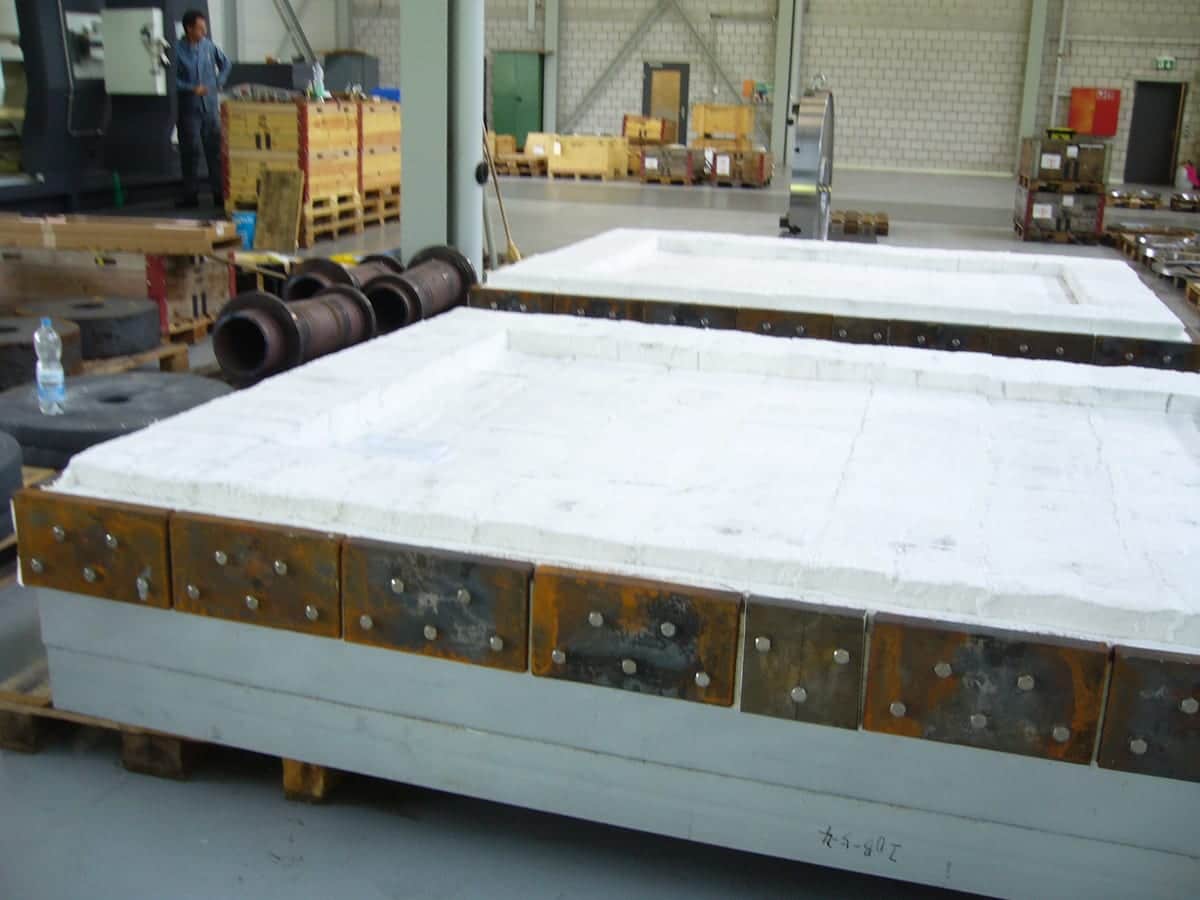
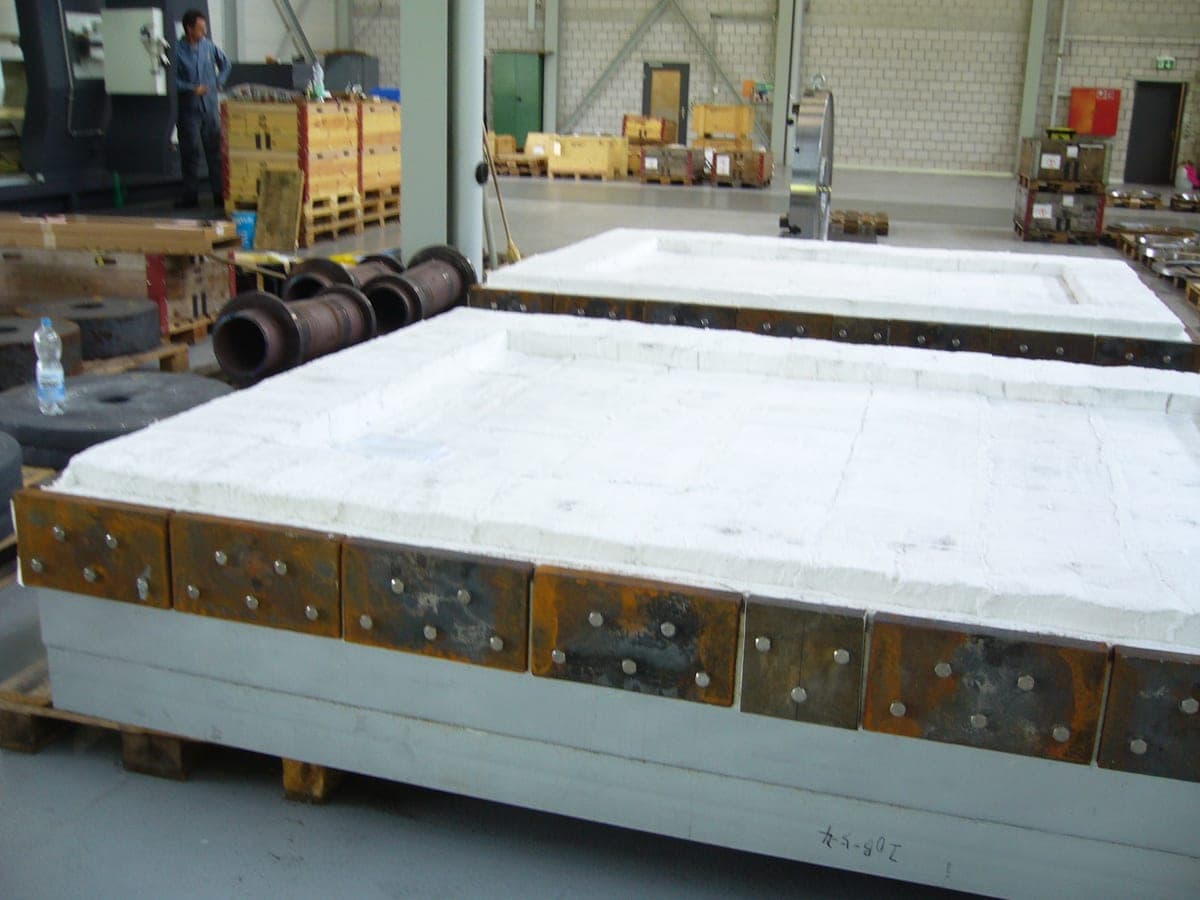
Furnace lids and hoods. They are a separate component with their own steel frame anyway. Lining them inside the furnace would be awkward; in the workshop they lie flat and accessible.
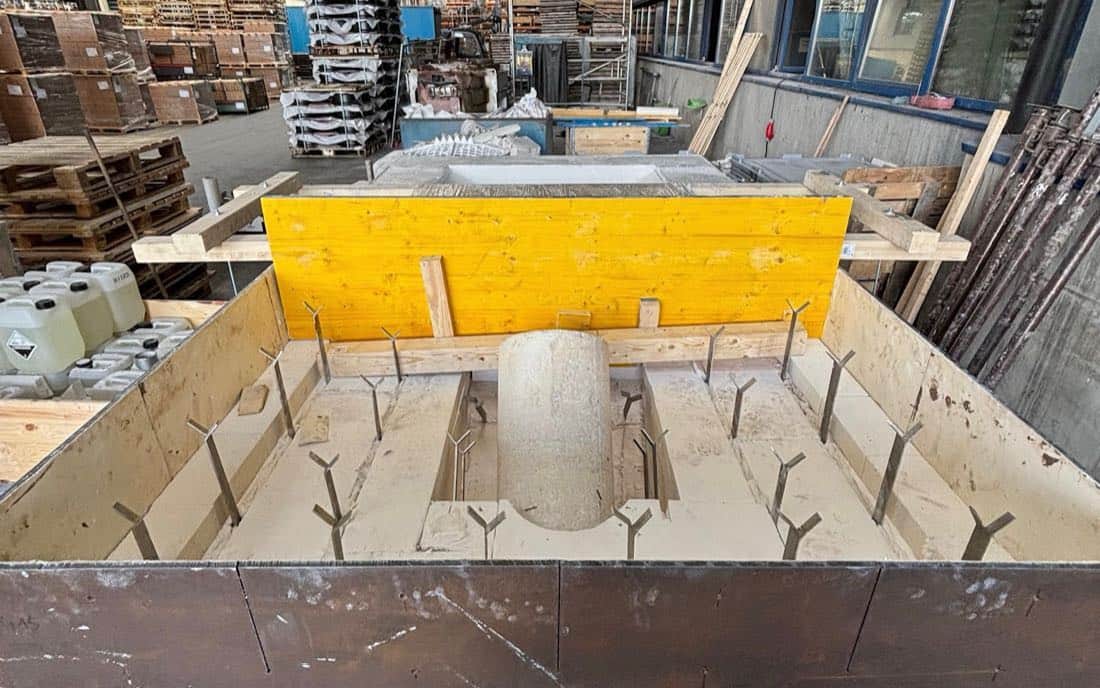
Launders, spouts and transfer points. Parts where dimensional accuracy decides the function and the formwork wants to be built without haste.
Rotors and internals. Components that rotate or are moved have to be balanced and checked before they go into the plant.
What ties into the existing lining, on the other hand — a wall area, a floor, a joint to the neighbouring zone — stays on site. A prefabricated part that has to meet old work on three sides brings more fitting problems than saved time.
Why the workshop is the better place to cast
Not because better people stand there, but because the conditions are better — and the same every time.
Inside a furnace you work in awkward postures, in changing light, with limited access and often against the clock. In the workshop the component stands at working height, the formwork can be aligned and checked, and if something is wrong it is stripped and done again — without a plant waiting for it.
Dry-out is where the real gain lies
The time advantage arises less during casting than afterwards. Freshly cast castable contains water, and how that water leaves decides the service life.
The curve takes its time. Holds at around 110, 350 and 600 degrees cannot be shortened without putting the lining at risk. Water expands many times over as steam.
In the workshop it runs in parallel. While the component dries, the plant keeps running. During a shutdown it does not.
Measured instead of estimated. In furnace operation the dry-out is often run on the unit itself. In the workshop a component can be fitted with thermocouples on purpose and the curve documented.
The risk stays in the workshop. If something spalls during drying that is annoying — but it extends no shutdown.
This is where prefabrication differs from simply working faster. It speeds nothing up. It moves the slowest step out of the window in which it hurts.
What remains to be done on site
Set, align, connect, hand over. Those are the tasks a prefabricated component still demands — and they can be planned, because none of them depends on what the demolition reveals.
Provided the survey is right. A prefabricated part is only as good as the dimensions it was built to — and those come from a survey of the cold furnace, not from an old drawing. That step cannot be saved, and it is the only one that must take place at the unit before the shutdown.
When it does not pay
When the survey is uncertain. A furnace whose internal dimensions have shifted over the campaigns gives no reliable basis. Then the formwork is built on site.
When the part ties in on several sides. The more connecting joints, the more fitting risk — beyond a certain point, monolithic installation on site is the safer route.
When transport endangers the component. Large thin-walled parts do not always survive the journey. What cracks on the road does not help in the shutdown.
When the window is generous anyway. In a turnaround lasting several weeks the time gain is no longer an argument — then only the quality of conditions counts, and that is still better in the workshop.
The decision is therefore not made across the board but component by component, and it is made during planning — not once the plant is already standing still.
Anyone planning the next shutdown window should ask early which parts actually have to be built inside it. Usually there are fewer than the quotation list suggests.
At a glance
The window
is the scarce quantity, not the man-hour
Dry-out
runs in parallel in the workshop, not in the shutdown
Same conditions
temperature, light, access — every time
The limit
whatever has to tie into existing work stays on site
We use cookies and similar technologies to ensure that our website functions properly and to analyse how our content is used. In the settings you can choose which cookies you wish to allow. Privacy policy

 PDFFurnaces with lids