Since January 2026 carbon dioxide has a price at the EU border, and free allocation in emissions trading is being phased out by 2034. Every tonne of CO₂ per tonne of product thus becomes a competitive factor — and the furnace wall, the heat-up after the overhaul and the unplanned shutdown enter the calculation. A commentary for operations and maintenance managers.
The carbon border adjustment mechanism, CBAM for short, is usually treated as a matter for purchasing and customs: anyone importing steel or aluminium from third countries has to pay for the emissions embedded in it. For a furnace operator in Europe, that sounds like a rule for others. It is not. CBAM is the second half of a movement whose first half arrives at your own plant: the free allowances in emissions trading are being phased out. At the end stands a simple key figure by which European producers will be compared in future — carbon dioxide per tonne of product. And every overhaul has a hand in that figure.
CBAM in brief
The legal basis is Regulation (EU) 2023/956. From October 2023 a transitional phase ran in which importers only had to report the emissions of their goods, without paying for them. That phase ended with the year 2025. Since January 2026, imports of iron and steel, aluminium, cement, fertilisers, hydrogen and electricity have been subject to the obligation to cover the embedded emissions with CBAM certificates; the price follows emissions trading. Following the 2025 simplification, however, the certificates for import year 2026 will only be purchased and surrendered from February 2027. The EU has since adjusted details such as thresholds, deadlines for purchasing certificates and calculation rules several times — anyone who imports themselves should check the current status. This article is not legal or tax advice but a look at the consequences in the furnace.
The real shift: free allocation is being phased out
In parallel with CBAM, free allocation in the EU emissions trading system is being reduced for the same sectors. As things stand, it will fall step by step from 2026, by around 2030 roughly half will be gone, and by 2034 it is to disappear completely for the CBAM sectors. Anyone who still covers a large share of their emissions with free allowances today will be paying for every tonne in a few years. As things stand, glass and lime works do not fall under CBAM, but they are also part of emissions trading — there too, every tonne saved turns into money.
This shifts what counts in overhaul planning. Until now the main question was: will the lining last until the next window? In future a second one comes on top: what does it cost in fuel and allowances while it lasts? Three items become visible that until now have disappeared into the gas or electricity meter: the heat loss through the furnace wall, the fuel for heat-up after every overhaul, and the unplanned shutdown with its second, unplanned heat-up.
Insulation is the biggest lever — and one you can rarely touch
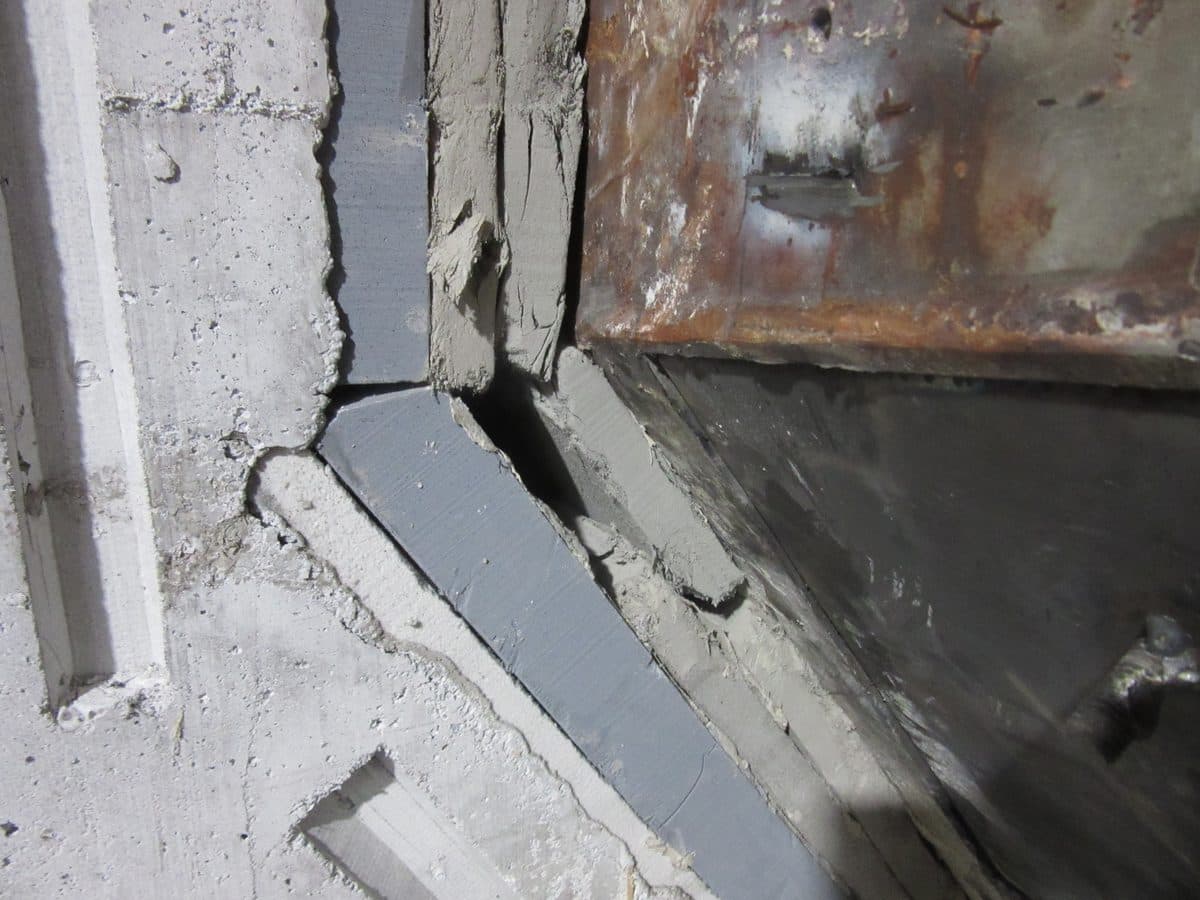
The working layer decides the service life, the layers behind it decide the heat loss. Many existing furnaces still carry backing insulation from the days when energy was cheap and CO₂ free of charge: lightweight bricks, compacted or embrittled fibre, boards that have absorbed moisture or melt over the years. Today calcium silicate boards and microporous boards are available that let considerably less heat through at the same thickness. Which build-up fits depends on temperature, atmosphere and furnace type — microporous boards, for example, belong protected behind a dense working layer, not where melt or moisture can reach them.
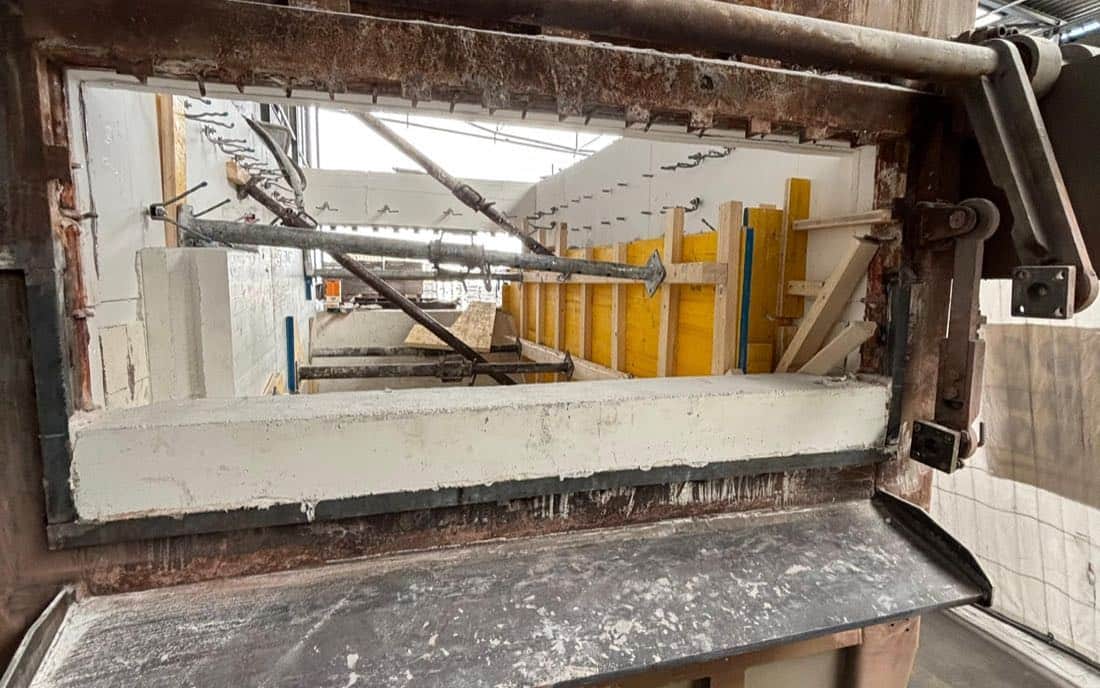
The catch: you only get at the insulation when the working layer is coming out anyway. A relining or a major partial repair is therefore the moment when the heat losses of the next ten or fifteen years are fixed. Anyone who plans that moment only around the question of which castable goes into the working layer gives away the larger part of the decision.
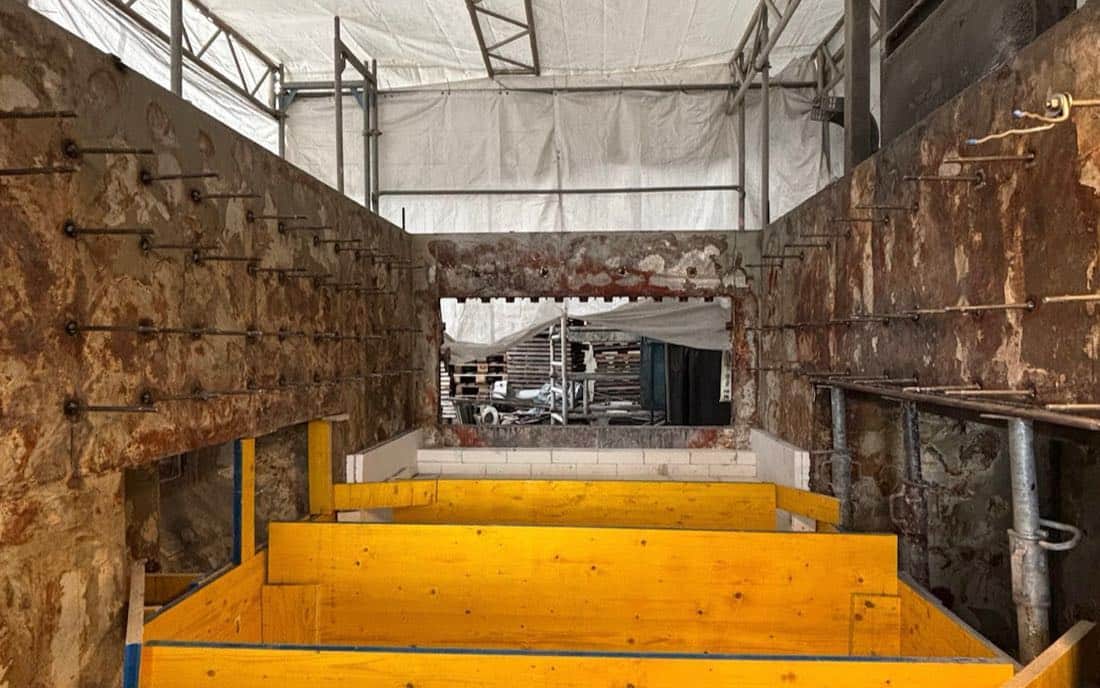
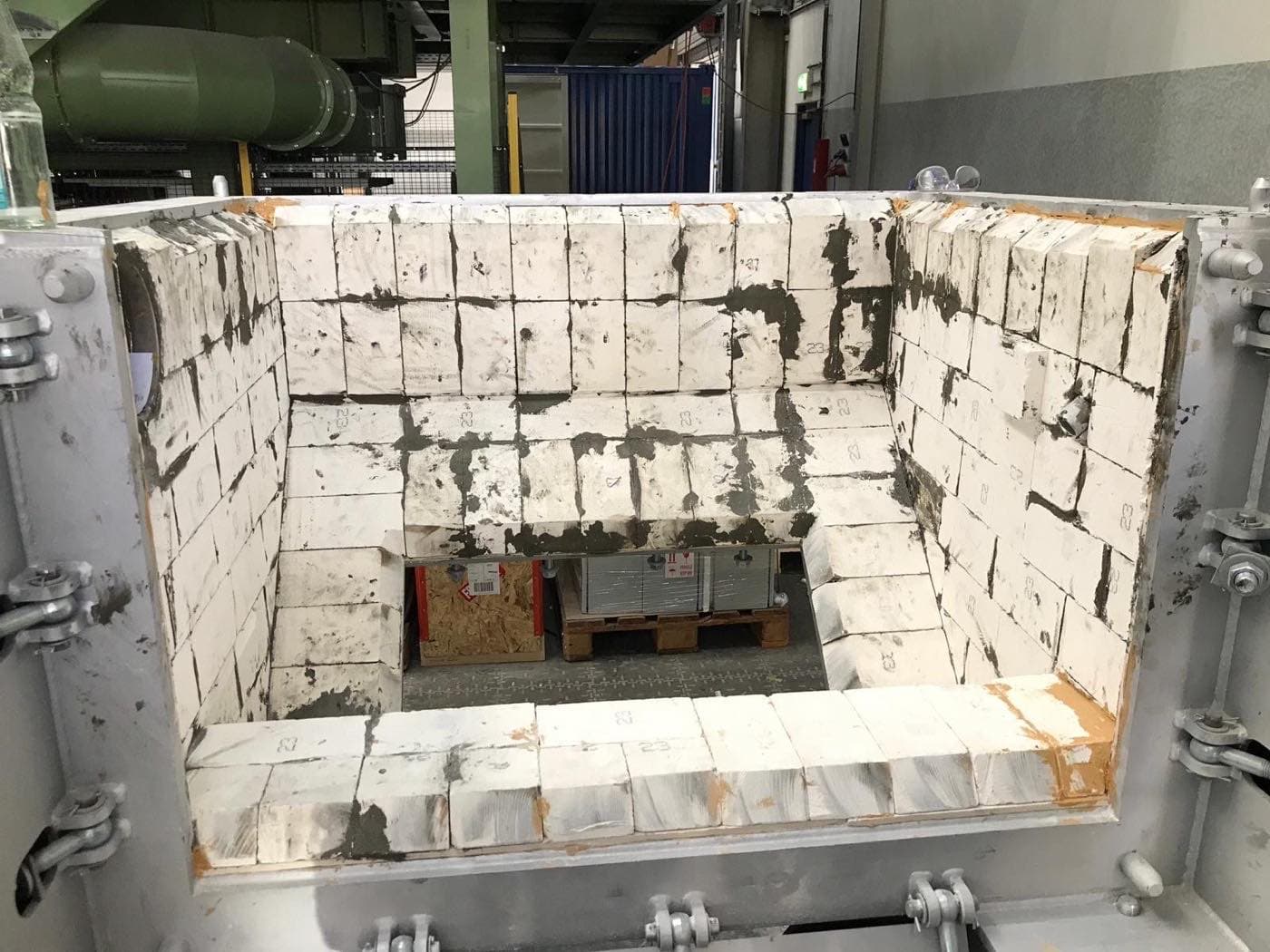
After the strip-out the steel shell is exposed. Now — and for years only now — the decision is made on which insulation goes behind the new working layer.
Shell temperature: the figure planning starts with
Whether a better wall build-up pays off is shown by the temperature of the furnace shell. It can be measured on the running furnace, ideally with a thermal imaging camera that captures the whole surface rather than individual points. Warm zones show where the insulation has grown thinner, slipped or become damp. Measured at the same load and the same furnace temperature, at fixed points and with a date, this becomes a trend — and the trend becomes a sound basis for deciding which wall sections belong in the next overhaul.
Worked example: an order of magnitude, not a quotation
A simple rough calculation shows how a shell temperature turns into money. The figures are an assumed example, not a measured value from a particular furnace. A steel shell at around 120 °C gives off about 1,500 W/m² at a hall temperature of 20 °C in still air, a shell at around 65 °C about 500 W/m². Assume a better wall build-up lowers the shell temperature on 100 m² of furnace wall from 120 to 65 °C, at 8,000 operating hours a year:
Less heat loss: 1,500 − 500 W/m² = 1,000 W/m², i.e. 1 kW per square metre.
Over the area: 1 kW/m² × 100 m² = 100 kW that the furnace no longer loses through the wall.
Over the year: 100 kW × 8,000 h = 800,000 kWh, i.e. 800 MWh of heat.
With natural gas at around 0.2 t CO₂ per MWh: 800 MWh × 0.2 t/MWh = 160 t CO₂ per year.
At a CO₂ price of 70 to 90 €/t: 160 t × 70 €/t = 11,200 € up to 160 t × 90 €/t = 14,400 € per year.
In the example, a better wall build-up saves around 800 MWh of heat and 160 t of CO₂ a year — at 70 to 90 €/t that is 11,200 to 14,400 € in CO₂ costs alone. The fuel comes on top, and because no burner works without losses, the actual gas consumption is higher than the heat saved. For your own furnace, the measured shell temperature, the real area and your own operating hours belong in this calculation.
Heat-up costs fuel before the first charge arrives
After every overhaul the new lining has to be dried and heated up. The heat-up curve protects the material against spalling caused by steam and must not be cut short — but it takes time, and every hour consumes fuel without the furnace producing. Here the choice of material has a direct influence: two-component castables are designed to tolerate considerably shorter drying and heat-up times than conventional cement-bonded mixes. How much shorter is stated in the manufacturer's data sheet and nowhere else. Anyone who plans the heat-up curve as early as material selection saves shutdown time and CO₂ at the same time.
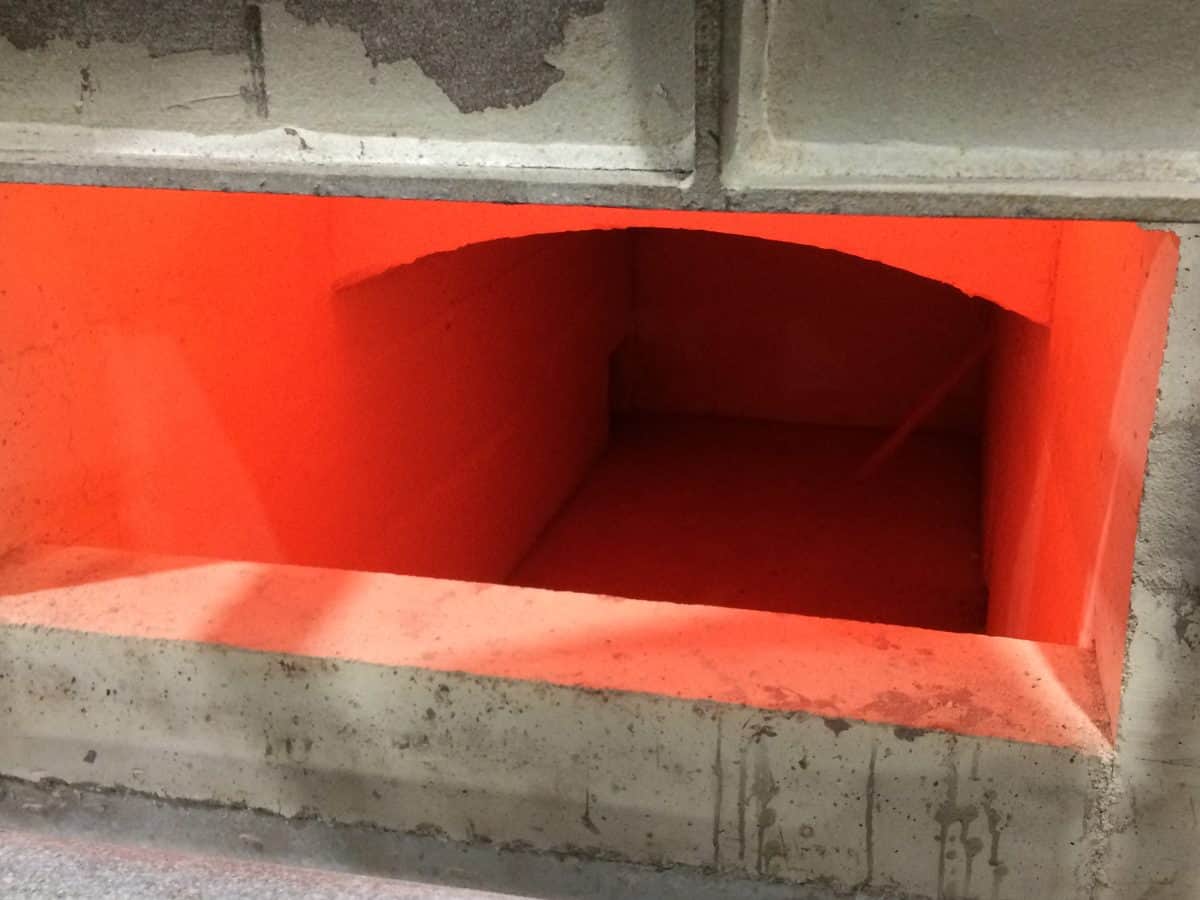
New lining at temperature: every hour of the heat-up curve consumes fuel before the first charge is in the furnace.
Bundle overhaul windows, avoid shutdowns
Every shutdown ends with a heat-up. Three small interventions a year mean three cooling and heat-up cycles, one bundled window only one. That argues for combining work: the partial repair at the bath line with replacing the insulation in the adjacent wall panel, the door seal with the burner block. The unplanned shutdown is more expensive still. It comes at the wrong time, often followed by an emergency heat-up, and in the CO₂ balance it appears as fuel without product. Regular inspections and thermography are therefore not only damage prevention but also energy policy on a small scale.
The documented condition becomes the basis for the balance
Energy audits, energy management and sustainability reports ask for figures that can be substantiated. For the furnace these are: wall build-up layer by layer, shell temperatures with date, heat-up curves with fuel consumption, shutdowns with cause. Anyone who keeps this data in the furnace file can justify an insulation measure with before and after values — to management, to the energy consultant or to a funding programme. Anyone who does not have it calculates with assumptions.
Survey the shell temperature of the running furnace by thermography, at fixed points and at the same load.
Record today's wall build-up layer by layer: material, thickness, year of installation.
At the next relining, reassess the backing insulation rather than simply installing it as before.
Select materials by drying and heat-up time as well, not only by service life.
Bundle small interventions into one overhaul window to save heat-up cycles.
Condition, measured values and heat-up consumption into the furnace file — as the basis for the energy and CO₂ balance.
CBAM and the phasing-out of free allowances make CO₂ per tonne of product a competitive factor. Overhaul planning has a say in what that figure looks like. The first step is a condition survey with thermography on the running furnace: it shows where the wall is losing heat and supplies the figures for your own calculation. SBS Refractory Service carries out this survey and assesses it together with the wall build-up.
At a glance
2026
end of the transitional phase: imports of steel, aluminium, cement, fertilisers, hydrogen and electricity have been subject to the certificate obligation since January, with purchase and surrender from 2027 (Regulation (EU) 2023/956)
2034
is when free allocation in the EU emissions trading system is, as things stand, to end completely for the CBAM sectors
160 t CO₂
per year in the worked example: 100 m² of furnace wall, 1 kW/m² less heat loss, 8,000 operating hours — 11,200 to 14,400 € at 70 to 90 €/t
We use cookies and similar technologies to ensure that our website functions properly and to analyse how our content is used. In the settings you can choose which cookies you wish to allow. Privacy policy



 PDFAll furnace types