

Lime & Cement
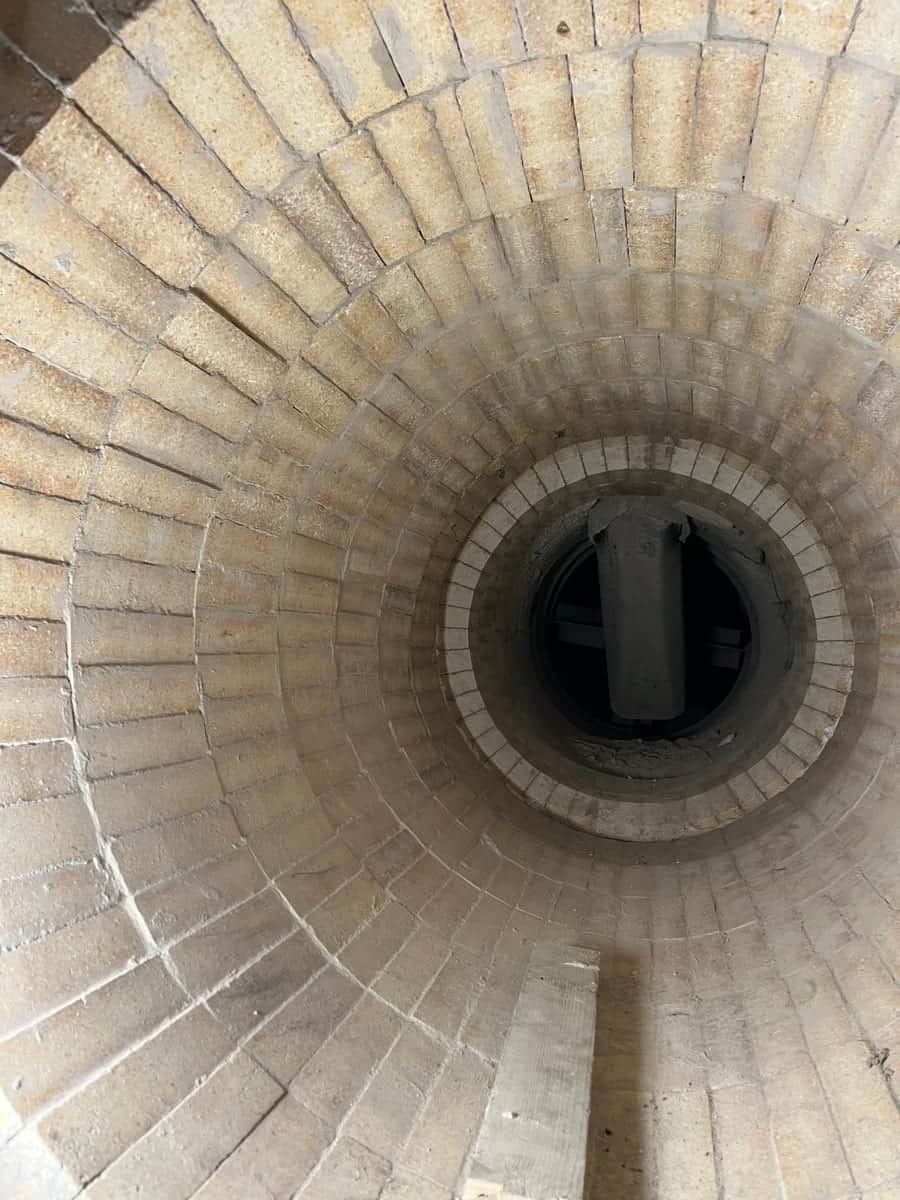
Circular furnaces carry their lining through the ring: every brick supports its neighbours, and that only holds as long as the ring is closed and sits true. We calculate the brick division for every diameter, distribute the compensation around the ring and leave the brickwork room to expand.
Refractory construction for Lime & Cement
In lime and cement plants the refractory lining is under a load found almost nowhere else: high temperature for months without interruption, chemical attack from the feed material and — in rotary kilns — the constant flexing of a shell that deforms under load. Anyone who economises on workmanship here pays for it in shutdown days.
The design decides the method. A circular shaft is bricked, and three things matter: a brick division calculated for every diameter, compensation distributed around the ring instead of collected in one place, and a surveyed starting ring. What is one millimetre out at the bottom stands twenty courses higher as visible offset.
An annular gap belongs between the brickwork and the furnace shell. The lining expands during heat-up; if it sits tight against the steel, it pushes itself apart. The anchors on the shell are therefore fitted with expansion caps. These are not details at the margin — they are the places where a ring lining opens up first.
Typical challenges
- A ring that stands on cut filler pieces is the first to open up — the compensation belongs distributed around the circumference
- If the brickwork sits tight against the furnace shell, it pushes itself apart during heat-up
- Small deviations in the starting ring grow over the height into visible offset
- Chemical attack from the feed material eats into the brick surface long before the thickness becomes critical
- In rotary kilns the shell works under load — the lining has to follow the flexing movement without tearing open
Furnace types in this industry
The right refractory solution for every furnace type.
Our services for Lime & Cement
From new build through repair to preventive maintenance.
Frequently asked questions
Everything you need to know about refractory construction in the Lime & Cement industry
Your question not listed?
Request personal adviceProjects from this industry
Further reading
Further industrial sectors
Planning a project?
Whether complete relining, repair or emergency — free initial consultation and a fast response.