
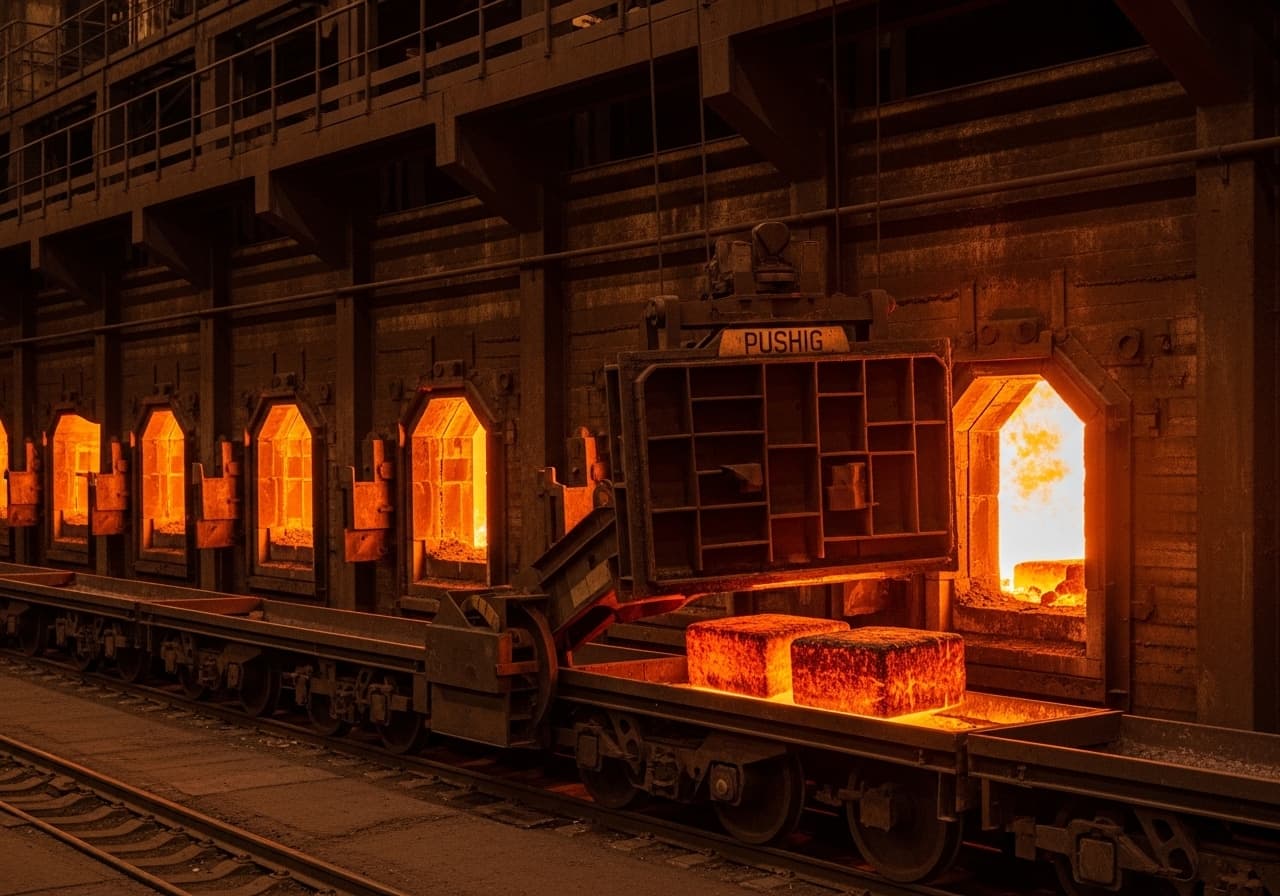
Coke oven battery
Refractory maintenance and repair of coke oven batteries producing coke for the blast furnace process.
Furnace profile at a glance.
Oven chambers
Narrow, tall chambers (approx. 0.4–0.6 m wide, 4–7 m high, 12–18 m long) of silica bricks. The chamber walls must be gas-tight, thermally stable and resistant to coke pressure. Cracking in the walls is the most frequent damage pattern.
Heating flues
Vertical ducts in the dividing walls between the oven chambers, in which gas is burned. Heating is applied alternately from above and below (underjet battery) or from the side. Damage to the heating flues impairs temperature distribution and the uniformity of coking.
Regenerators
Heat accumulators beneath the oven chambers that preheat the combustion air and the heating gas. Filled with checker or bulk bricks of silica or fireclay. Blockages and slagging reduce the thermal efficiency of the battery.
Roof arch
Arched cover over the oven chambers made of specially shaped silica bricks. The arches are at risk from coke pressure and thermal loading. Subsidence and cracks require elaborate repairs or brick replacement.
Door frames
Metal frames at the ends of the oven chambers that hold the oven doors. The frames warp over the service life and must be reworked regularly. The refractory seal between the frame and the brickwork is critical to gas tightness.
Maximising service life through precise maintenance.
The coke oven battery is a highly complex refractory structure of thousands of silica bricks, operated under permanent thermal loading at temperatures of 1,000 to 1,300 °C. Coking of coal into blast furnace coke is a continuous process in which the battery is kept in the hot state for decades. SBS Refractory Service GmbH has specialised experience in the refractory maintenance of these unique units.
The greatest challenge with coke oven batteries lies in maintaining the thin-walled chamber walls and heating flues in the hot state. Cracks and leaks between the oven chamber and the heating flue must be repaired quickly and reliably in order to preserve gas tightness and thermal efficiency. SBS relies on proven methods such as ceramic welding, silica brick replacement and mortar injection for long-lasting repair results.
A coke oven battery is an investment for decades. With consistent maintenance, modern batteries achieve service lives of 30 to 40 years and more. SBS supports coke plants with regular inspections, predictive maintenance planning and rapid repair assignments — so that your battery reaches its full service life. Our experienced teams are familiar with the particular hazards of coke plant work.
Typical problems with the Coke oven battery.
These loads determine the choice of material and the design of the refractory lining.
Cracking in chamber walls
The thin silica walls between the oven chamber and the heating flue are subject to thermal stresses and to loading from coke pressure. Cracks lead to gas crossover, which impairs coke quality and creates safety risks. Early detection and repair are decisive.
Ensuring gas tightness
Gas tightness between the oven chambers and the heating flues is critical to operation. Leaks lead to uncontrolled gas flow, explosive mixtures and exceedance of emission limits. Regular inspections and immediate repairs are indispensable.
Working in the heat
All repairs to coke oven batteries take place in the hot state at temperatures above 1,000 °C. The battery must not be cooled down, as this would cause irreversible damage to the silica brickwork. This calls for specialised hot repair methods and extreme protective measures.
Coke oven gas exposure
Coke oven gas contains toxic components such as carbon monoxide, benzene and hydrogen sulphide. All work requires permanent gas measurement, respiratory protection on standby and strict access control. SBS employees receive dedicated training for these hazards.
Age-related deformation
Over the decades, coke oven batteries deform as a result of silica conversion and thermal creep. Door frames warp and roof arches subside. SBS assesses the condition and develops adapted repair concepts for ageing batteries.
Materials & lining
Every zone of your furnace places its own demands on temperature resistance, chemical resistance and mechanical load capacity. We select the optimum material combination.
Click on a material for details
Silica bricks
Refractory bricksChamber walls and roof arches
Ceramic welding mix
MonolithicCrack repair on chamber walls in the hot state
Typical work on the Coke oven battery.
Our services for this furnace type — from complete relining to ongoing maintenance.
From site inspection to acceptance.
Our structured process ensures quality, on-time delivery and safety in every project.
Assessment & site inspection
Regular assessment of the chamber walls, heating flues and roof arches for cracking.
Planning
Development of a repair concept using ceramic welding or partial brick replacement.
Execution
Ceramic welding repairs on chamber walls, replacement of defective roof bricks.
Safety
Gas-free measurements before entry, protective equipment against coke oven gas and high temperatures.
Assessment & site inspection
Regular inspection of the coke oven battery is the basis for predictive maintenance. Endoscopic examinations through the door openings and inspection ports record the condition of chamber walls, heating flues and roof arches. Cracks, deformation and material loss are mapped and documented in a digital condition report. The results feed into the prioritisation of repair measures.
Planning
Based on the inspection report, a repair concept is developed that defines the type, scope and sequence of the measures. Ceramic welding is planned for cracks in chamber walls, and partial brick replacement for more extensive damage. Coordination with the operating schedule ensures that repairs are carried out in empty chambers during their idle time. Materials and personnel are scheduled.
Execution
The repair work is carried out with the battery in the hot state. In ceramic welding, a mixture of refractory powder and oxygen is applied to the damaged area, where it reacts exothermically and permanently seals the crack. For more extensive repairs, individual bricks are replaced through the oven doors. Regenerators are cleaned and refilled where necessary. All work requires specialised equipment and trained personnel.
Safety
Safety has absolute priority in coke plant work. Before every entry, gas-free measurements for CO, H₂S and benzene are carried out. Breathing apparatus is available at all times. Heat-resistant PPE protects against radiant heat. Rescue plans with trained rescue teams are in place on site. All employees receive regular instruction in coke plant hazards and hold safety training.
From our project portfolio.
Over 500 successfully completed refractory construction projects in the DACH region and the Benelux countries.
Coke oven battery
Frequently asked questions
Everything you need to know about the Coke oven battery
Go deeper.

You may also be interested in.
Planning a project?
Whether complete relining, repair or emergency — free initial consultation and a fast response.