
Refractory enclosure lining
The enclosure lining is a mineral-bonded layer on the inner face of a battery storage enclosure. It does not burn itself and is intended to protect the load-bearing outer shell from direct heat exposure in a fault condition.
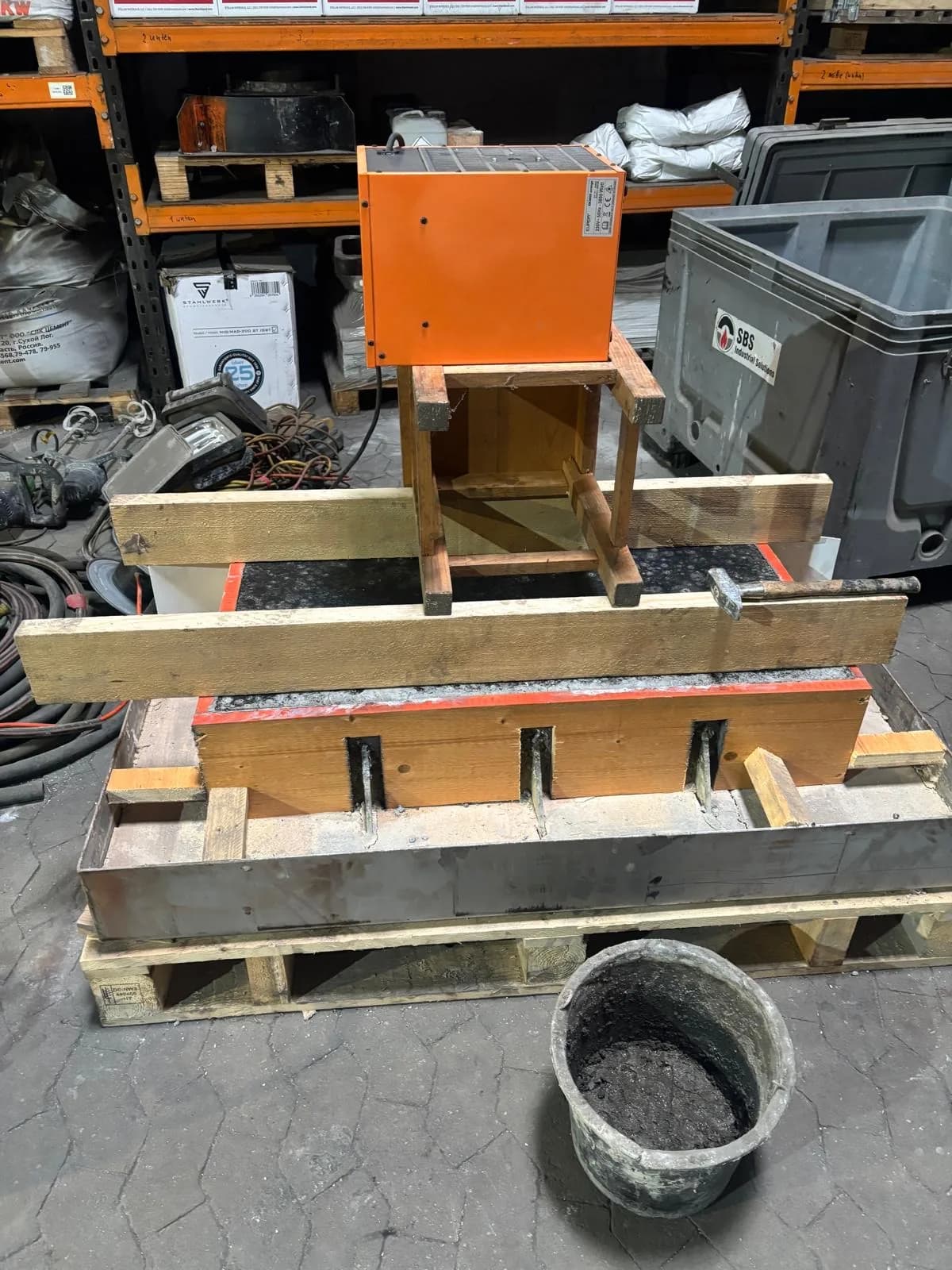
Refractory enclosure lining
Typical initial situations
Battery storage systems are increasingly being installed where people work: in production halls, alongside plant buildings, in densely built-up commercial areas. This raises the demands placed on the enclosure. A steel shell conducts heat and loses strength at high temperatures — a mineral internal lining does neither.
For this we use the same materials that operate permanently in the high-temperature range in our furnace projects: cement-bonded castables, lightweight castables and ceramic fibre insulation. For a storage enclosure, these castables are considerably over-dimensioned in terms of peak temperature — which is precisely why they meet the requirements for non-combustibility and mechanical strength with a wide margin.
What we supply is the lining together with material certification and installation documentation. The enclosure design, its structural engineering and the certification of the overall system are the responsibility of the system manufacturer — we work as a supplier to their scope.
At a glance
- Design data or interface dimensions of the enclosure required
- Wall thickness and permissible additional weight to be agreed early
- Concrete is porous — moisture tightness must be solved separately
- For outdoor installation, allow for freeze-thaw resistance
- Openings for cables, ventilation and pressure relief to be defined in advance
- System certification remains with the enclosure or system manufacturer
How we work on Refractory enclosure lining
Proven methods and specialised equipment for optimal results.
Casting in formwork
The castable is placed into formwork and compacted. This produces a seamless, dimensionally accurate layer — suitable for flat surfaces and prefabricated wall segments.
Gunning application
Machine application onto existing internal surfaces. Useful for existing enclosures and complex geometries where formwork cannot be erected economically.
Prefabricated preformed shapes
Production of individual panels and partition elements in our workshop. The system manufacturer installs them on their own line — with no refractory specialists needed on site.
Sandwich construction
A combination of load-bearing castable and ceramic fibre insulation, where low thermal conductivity in normal operation is required alongside non-combustibility.
Step by step to the result
Structured, transparent and on schedule — this is how we work.
Requirements review
Recording of geometry, wall thickness, weight limits, installation site and the interfaces with racks and cooling.
The result is a concise specification that guides the material selection. Without these boundary conditions, any material recommendation remains speculation.
Material proposal
Selection of suitable castables from our range, with data sheets and a substantiated recommendation.
The candidates are compared against your requirements for thermal conductivity, weight, processing and moisture behaviour.
Sample part
Production of a wall segment or partition element at 1:1 scale.
You assess surface finish, edge formation, weight and installation in practice before series quantities and prices are fixed.
Documentation
Provision of the material certification for your scope of work.
Material certificates, fire classification to DIN EN 13501-1 and the characteristic values you require for your system certification.
Installation
Execution by our own installation teams — at your plant or prefabricated at our works.
With an installation record and acceptance report, as is customary in our furnace projects.
Material flows in Refractory enclosure lining
Proper separation, recovery and disposal of all resulting materials.
Lightweight castable
AVV CastableLightweight castable with reduced bulk density. The first choice where weight and lower thermal conductivity matter alongside non-combustibility.
SOLUT Cast FL
AVV Wear protectionCement-bonded material that can be trowelled, cast and gunned. Suitable for areas subject to mechanical loading or for application onto existing internal surfaces.
SOLUT CAST FL 85
AVV Low-cement castableLow-cement castable with high strength. An option where the lining itself takes on structural tasks.
SOLUT Blanket
AVV Fibre insulationFibre insulation as an intermediate layer where the thermal conductivity of the overall construction has to be reduced further.
Typical initial situations
Typical situations in which Refractory enclosure lining is used.
The storage system is to be installed inside a production hall
The fire protection concept at the installation site requires a non-combustible design
Installation close to buildings or neighbouring properties
Existing steel enclosures are to be retrofitted
A system manufacturer is looking for a supplier for the internal lining
The tender requires material certification for the inner face of the enclosure
Frequently asked questions
Everything you need to know about Refractory enclosure lining
Your question not listed?
Request a personal consultationYou may also find this of interest
Planning a project?
Whether complete relining, repair or emergency — free initial consultation and a fast response.