
Hazardous substances & contamination
Survey, assessment and removal of materials containing hazardous substances in industrial buildings and plants. Covers all common building pollutants as well as the types of contamination typical of industry in soils and building components.
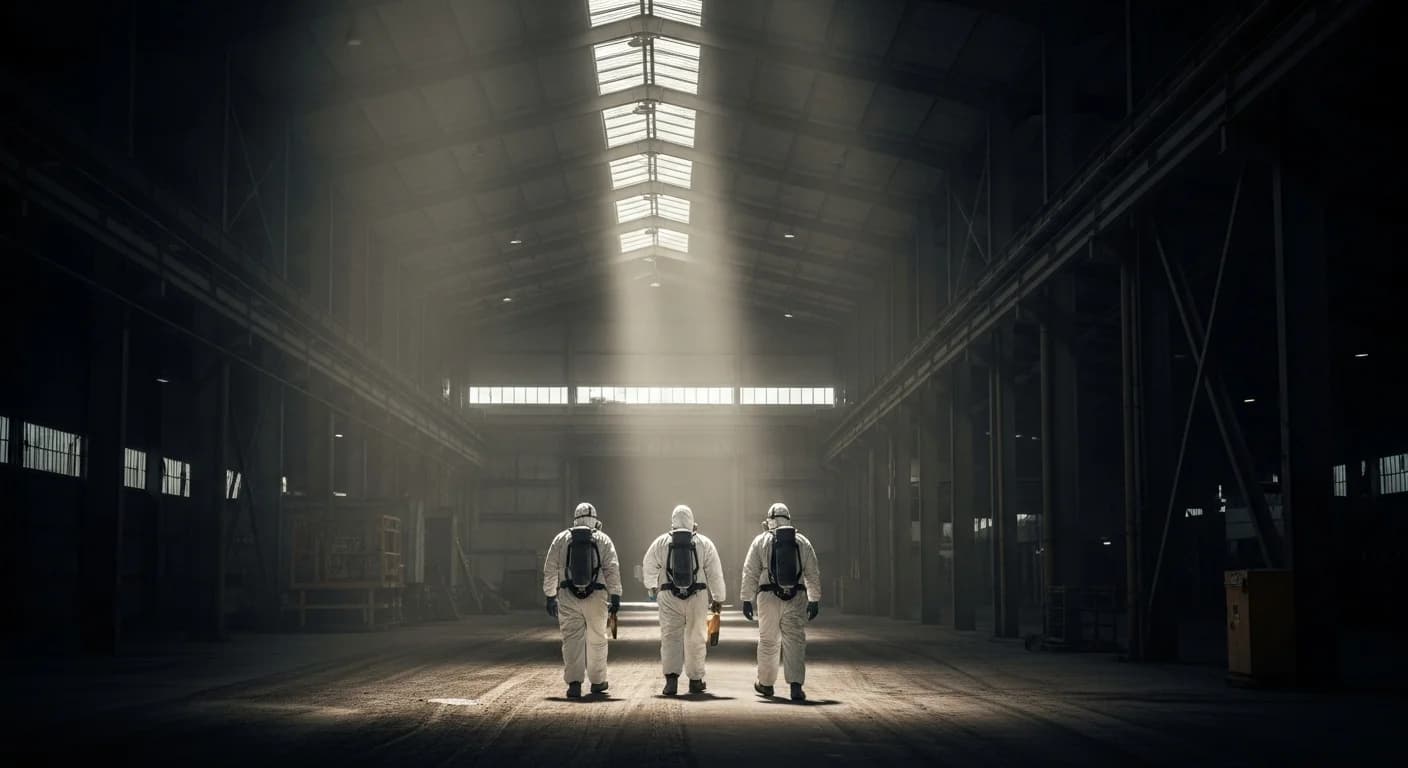
Hazardous substances & contamination
When is this service relevant?
Industrial buildings and plants dating from the 1950s to the 1990s regularly contain hazardous substances: asbestos in roof coverings, façade panels and seals, man-made mineral fibres (MMMF) such as ceramic fibres and old mineral wool in thermal insulation, PCBs in joint sealants and capacitors, PAHs in adhesives and waterproofing.
Hazardous-substance remediation is not demolition work — it is a regulated specialist trade with its own permit procedures, qualification requirements and technical rules. Improper removal spreads fibres and pollutants in an uncontrolled way and creates liability risks.
SBS has experienced specialist personnel, its own clean/dirty changing facilities, negative-pressure units and measuring equipment for fibre and indoor air measurements. We carry out the remediation — and we document it so that it withstands scrutiny by the authorities.
At a glance
- Hazardous substance report as the basis before remediation begins
- Notification to the competent authority (e.g. the trade supervisory authority) at least 7 days before work starts
- Experienced specialist personnel for hazardous substance remediation
- Occupational health care in accordance with ArbMedVV (asbestos, respiratory protection), taking the AMR into account
- Indoor air measurements during and after the remediation
- Obtain the disposal record before work begins
How we work on Hazardous substances & contamination
Proven methods and specialised equipment for optimal results.
Sampling & analysis
Systematic material sampling on suspect building components. Laboratory analysis for asbestos fibres (SEM/EDX), MMMF (fibre geometry), PCBs (GC/MS) and PAHs. The result is a hazardous substance register.
Clean/dirty changing facility
Personnel airlock with a three-chamber system: dirty area (contaminated), shower, clean area. Prevents fibres and pollutants being carried out of the remediation area.
Negative-pressure containment
The remediation area is sealed off airtight and held at a negative pressure of at least −20 Pa by negative-pressure units. The extracted air passes through HEPA H14 filters. This prevents any uncontrolled release of fibres into adjoining areas.
Clearance measurement
Once the remediation is complete, the fibre concentration in the remediation area is measured (gold coating / SEM). Release only follows once the asbestos fibre concentration is below the clearance value of 500 fibres/m³ (upper confidence limit below 1,000 fibres/m³, measurement to VDI 3492).
Step by step to the result
Structured, transparent and on schedule — this is how we work.
Hazardous substance survey
Site walkover, sampling, laboratory analysis. Preparation of a hazardous substance register with a site plan and quantity schedule.
Sampling strategy in accordance with VDI 6202 Part 3. Analysis by accredited laboratories. Assessment of the urgency and of the options for action.
Remediation planning
Work and safety plan in accordance with TRGS 519, disposal concept, scheduling, notification to the authorities.
Definition of the remediation areas, specification of the technical protective measures, selection of the disposal routes. Obtaining the disposal records.
Setting up the remediation area
Sealing off, erection of the clean/dirty changing facility, installation of the negative-pressure containment, setting up of the material airlock.
Double-layer sheeting walls with taped joints. Negative-pressure units with an emergency power supply. Camera monitoring of the remediation area.
Hazardous substance removal
Removal of the materials containing hazardous substances within the sealed-off area. Packaging in labelled big bags or panel containers.
Wet working for asbestos, low-dust disassembly for MMMF. Continuous measurement of the fibre concentration. Documentation of every batch with a weighbridge ticket.
Clearance measurement & release
Fine cleaning, indoor air measurement in accordance with VDI 3492, evaluation by an accredited laboratory. Clearance certificate.
Clearance value: < 500 fibres/m³ (asbestos, measured to VDI 3492) or in accordance with TRGS 521 (MMMF). Only once the value has been undercut: removal of the sealing and of the clean/dirty changing facility.
Material flows in Hazardous substances & contamination
Proper separation, recovery and disposal of all resulting materials.
Asbestos (firmly bound and weakly bound)
AVV 17 06 01*Roof panels, façade panels, pipe insulation, sealing cords, brake linings, Floor-Flex tiles. Weakly bound asbestos (sprayed asbestos) is particularly hazardous.
Man-made mineral fibres (MMMF): ceramic fibres and old mineral wool
AVV 17 06 03*Ceramic fibres as high-temperature thermal insulation in furnaces, pipework and ducts; older mineral wool (pre-2000) with biopersistent fibres in buildings and plants. Both belong to the MMMF group; work in accordance with TRGS 521.
Components containing PCBs
AVV 17 09 02*Joint sealants (Thiokol compounds), capacitors, ballasts, paint coatings. PCB limit value: 50 mg/kg — above this it counts as hazardous waste.
Materials containing PAHs
AVV 17 03 01*Tar adhesives beneath parquet flooring, roofing membranes, black paint coatings on cellar walls. Analysis for the 16 EPA PAHs, with benzo(a)pyrene as the marker substance.
When is this service relevant?
Typical situations in which Hazardous substances & contamination is used.
Mandatory remediation before the demolition or conversion of buildings containing hazardous substances
Official order following a hazardous substance finding
Planned change of use of contaminated industrial buildings
Roof remediation or façade work on asbestos-contaminated buildings
Incident involving fibre release (MMMF, asbestos)
Removal of old furnace linings with suspected hazardous substances
Frequently asked questions
Everything you need to know about Hazardous substances & contamination
Your question not listed?
Request a personal consultationYou may also find this of interest
Planning a project?
Whether complete relining, repair or emergency — free initial consultation and a fast response.